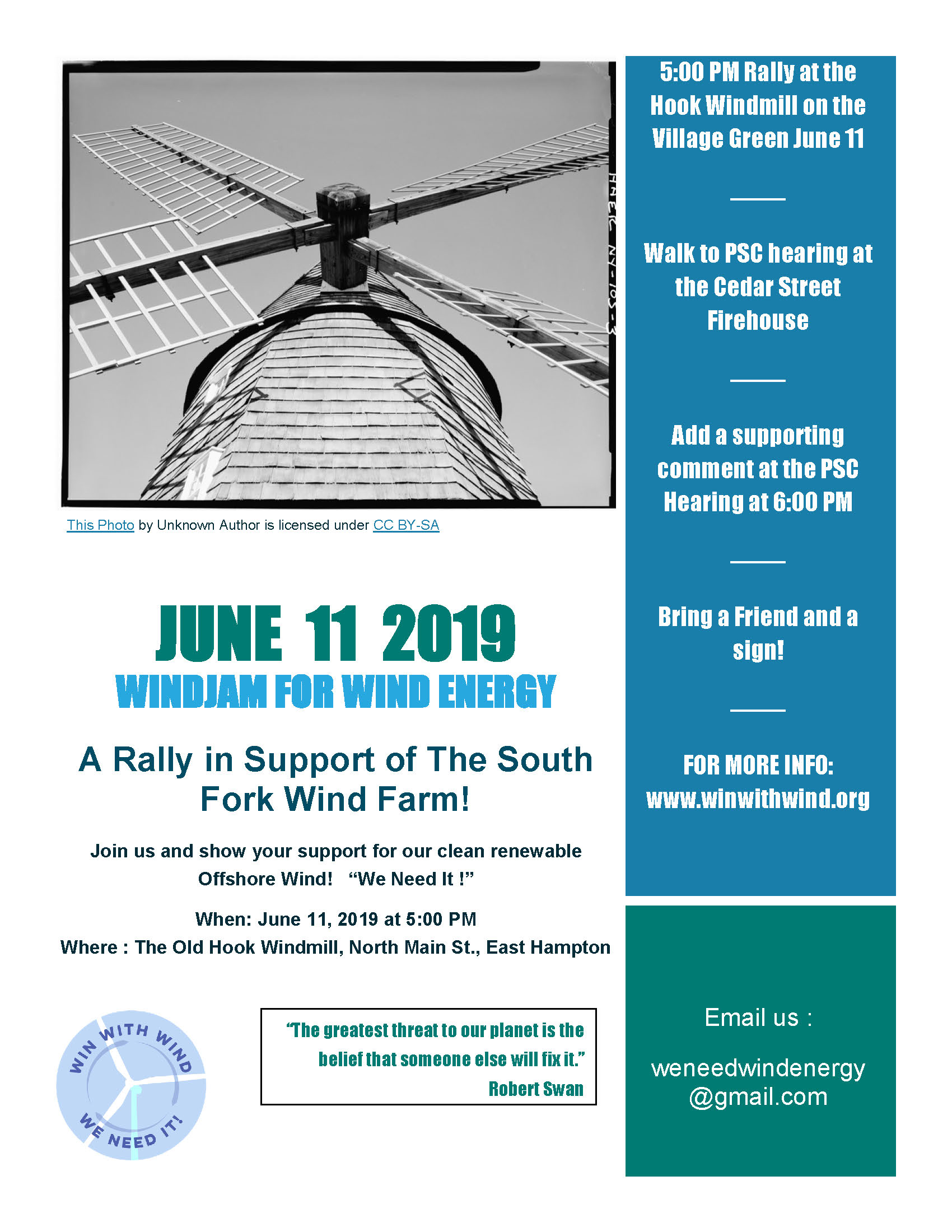
Rally for the South Fork Wind Farm – June 11, 2019
Image
1
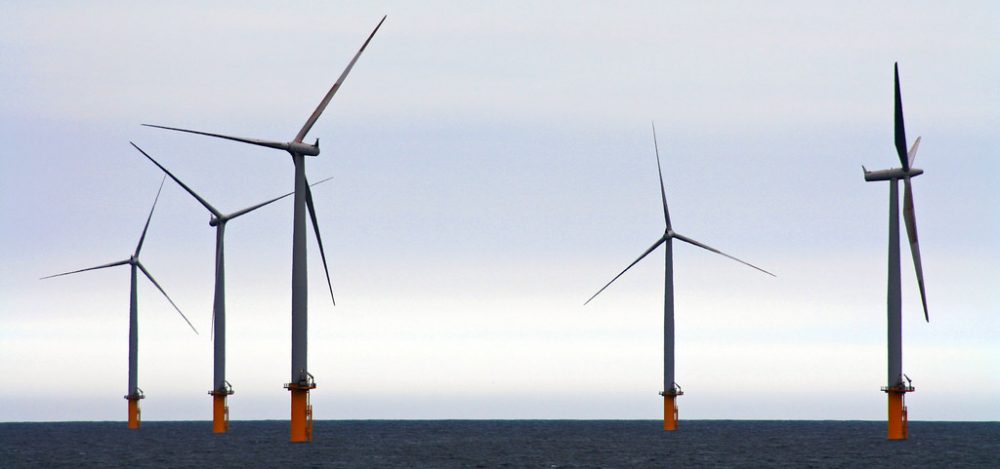
This is a cross section (a real piece) of the existing Block Island cable for their wind farm, consisting of 5 wind turbines that produce all the energy for the island with surplus energy for the state of Rhode Island. It is on my kitchen table. It measures 7 inches in diameter. It is similar to the cable that will bring energy from the South Fork Wind farm ashore.

“Carbon-free New York by 2040” is the overriding goal. Period.
If the urgency of achieving this goal is not apparent to any readers, just look at the most recent local news: “Higher tides force Shelter Island Ferry to rebuild ramps” This is a very real cost of sea level rise here on the South Fork! Check it out via Newsday.com.
And this is just the beginning.
On the other side of the issue we have loud opponents of the South Fork wind farm:
1) wealthy homeowners, with mansions on the Wainscott beach, who oppose any cable coming ashore in their vicinity, clearly a case of NIMBY
2) fishermen that have been whipped up with scare tactics. I note that there are only 2 commercial fishing boats out of Montauk that fish in the Southfork wind farm area (OCS-A 0486, near Cox Ledge) which is closer to Rhode Island and Martha’s Vineyard than to Montauk. From Montauk it takes 5 hours to get there by boat and 5 hours back.
For all those worried about a disruptive cable running under the sea bed and coming ashore somewhere, I would point out that a larger electric cable already feeds power in to Long Island coming all the way from New Jersey. This dates back to 2007! Like a giant extension cord, this transmission cable, named Neptune, stretches 50 miles underwater from Sayreville, N.J., comes ashore at Jones beach and has been plugged into Long Island for all these years without any nefarious effects on, or off shore. It is a 10″ cable and provides 660 megawatts.
Likewise LIPA imports power from New England on the 330-megawatt Cross Sound Cable, which runs underwater from Connecticut. Two older cables, the 600-megawatt Y49 cable and the 599-megawatt Y50 cable, also run under the Sound to the Island.
Initial concerns about the effects on the shell fish industry were apparently not a problem over all these years.
Read more here:

As the per the Sierra Club, the first offshore wind project in New York is in jeopardy — act today to make sure we build the clean renewable, energy we need to meet New York’s bold climate commitments.
New York has made bold climate commitments to power our state with 100% clean, renewable energy by 2040. The South Fork Wind Farm is a critical clean, renewable energy project that will help us meet this goal, but a few vocal opponents are trying to slow down renewable energy and climate progress.
You can play a role. The Public Service Commission (PSC) is collecting public comments. Let Governor Cuomo and the PSC know we must get this first offshore wind project built to lay the groundwork for future wind projects and to meet our bold climate and clean energy goals.
STATE OF NEW YORK PUBLIC SERVICE COMMISSION
CASE 18-T-0604 -Application of Deepwater Wind South Fork, LLC for a Certificate of Environmental Compatibility and Public Need for the Construction of Approximately 3.5 Miles of Submarine Export Cable from the New York State Territorial Waters Boundary to the South Shore of the Town of East Hampton in Suffolk County and Approximately 4.1 Miles of Terrestrial Export Cable from the South Shore of the Town of East Hampton to an Interconnection Facility with an Interconnection Cable Connecting to the Existing East Hampton Substation in the Town of East Hampton, Suffolk County.
PLEASE TAKE NOTICE that public comment is sought on a request by Deepwater Wind South Fork, LLC, (Deepwater) for authorization to build and operate an electric transmission line. If granted, Deepwater would be authorized to build an approximately 3.5 mile submarine export cable from the New York State Territorial Waters boundary to the South Shore of the Town of East Hampton in Suffolk County and approximately 4.1 miles of 138 kV terrestrial export cable from the South Shore of the Town of East Hampton to an interconnection facility with an interconnection cable to an existing East Hampton Substation (the Project). The Project would connect the proposed South Fork Wind Farm, located in federal jurisdictional waters on the Outer Continental Shelf, to the existing mainland electric grid in the Town of Easthampton.
PLEASE TAKE NOTICE that opportunities for public information and comment regarding Deepwater’s request will be provided as follows:
Date: June 11, 2019
Location: East Hampton Firehouse
1 Cedar St
East Hampton, NY 11937
Afternoon: Information Forum – 2:00 PM
Public Statement Hearing – 3:00 PM
Evening: Information Forum – 6:00 p.m.
Public Statement Hearing – 7:00 p.m.
During the scheduled informational forums, maps of the proposed route will be available to review, New York State Department of Public Service Staff representatives will give a short presentation on the review process in this case, and Deepwater representatives will be available to answer questions about its proposal. The public is welcome to stop in at any time during the informal informational forums to review information and ask questions.
Each informational forum will be followed by a public statement hearing where all those wishing to comment on Deepwater’s request will have an opportunity to make a statement on the record before an Administrative Law Judge. It is not necessary to make an appointment in advance, or present written material to speak at the hearing. Persons will be called to speak after completing a request card. Each public statement hearing will be held open for at least one-half hour and, where practicable, will be kept open until everyone wishing to speak has been heard or other reasonable arrangements have been made. A verbatim transcript of each hearing will be made for inclusion in the record of this proceeding.
Persons with disabilities requiring special accommodations should call the Department of Public Service’s Human Resources Management Office at (518) 474-2520 as soon as possible. TDD users may request a sign language interpreter by placing a call through the New York Relay Service at 711. Individuals with difficulty understanding or reading English are encouraged to call the Commission at 1-800-342-3377 for free language assistance services regarding this notice.
Other Ways to Comment
For those who cannot attend or prefer not to speak at a public statement hearing, there are several other ways to comment about this case to the Commission. Comments should refer to “Case 18-T-0604 – Deepwater.”
Internet or Mail: Go to www.dps.ny.gov, click on “Search,” search using case number “18-T-0604” and then click the “Post Comments” button at the top of the page; or send comments to the Secretary for the Commission atsecretary@dps.ny.gov. Alternatively, comments may be mailed or delivered to Hon. Kathleen H. Burgess, Secretary, Public Service Commission, Three Empire State Plaza, Albany, New York 12223-1350.
Toll-Free Opinion Line: You may call the Commission’s Opinion Line at 1-800-335-2120. This number is set up to take comments about pending cases from in-state callers, 24 hours a day. These comments are not transcribed verbatim, but a summary is provided to the Commission.
Although comments submitted via these alternate means will be accepted throughout the pendency of this proceeding, they are requested by July 12, 2019. Written comments received by the Department will become part of the record considered by the Commission. Written comments may be viewed online (go to www.dps.ny.gov, click on “Search,” search using the case number and then click on the “Public Comments” tab). Many libraries offer free Internet access. The application may be viewed at www.dps.ny.gov (search using the case number) or at the East Hampton Library (East Hampton), the Hampton Library Central Library (Bridgehampton), the Amagansett Free Library Central Library (Amagansett) or the Springs Library (East Hampton).
(SIGNED)
KATHLEEN H. BURGESS
Secretary
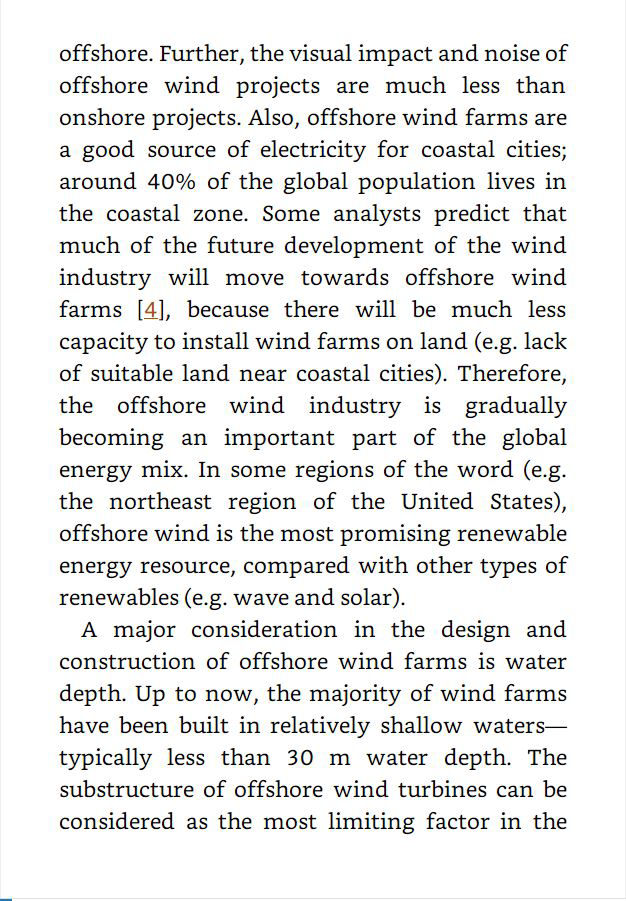
Facts: Wind energy is an indirect form of solar energy. Wind energy is stronger and more reliable offshore here because wind energy is affected by friction and the rotation of the Earth (Coriolis). Friction near the surface of land and ocean is called “surface roughness.” Surface roughness includes buildings, topography, forests, and on the ocean surface: waves. “Therefore the Offshore Wind Industry is gradually becoming an important part of the global energy mix. In some regions of the world (e.g. the northeast region of the United States ), offshore wind is the most promising renewable energy resource.” Fundamentals of Ocean Renewable Energy: Generating Electricity from the Sea,Simon Neill M Reza Hashemi, eBook ISBN: 9780128104491, Imprint : Academic Press Published Date: 12th June 2018.
But is there wind in the summer? Opponents to renewable energy say “No”. However a new study at Rutgers University dispels that myth.
“The Rutgers study, published last September, found that not only do sea breezes travel three times farther offshore than onshore, but that the breezes are stronger during upwelling conditions, most common in the summer and fall, which is when water in deeper levels of the ocean rise to the surface. Thanks to the study, developers now know which months to expect the greatest potential wind energy.”
From: Cate Rogers
Textbook by Simon P. Neill and Reza Hashemi

•
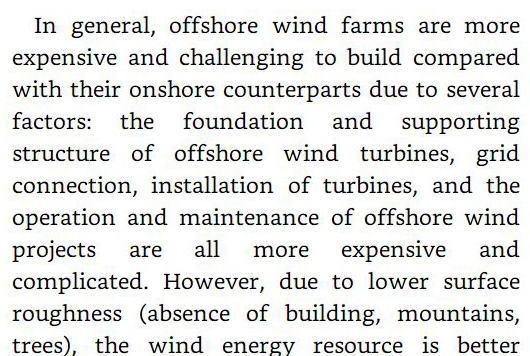
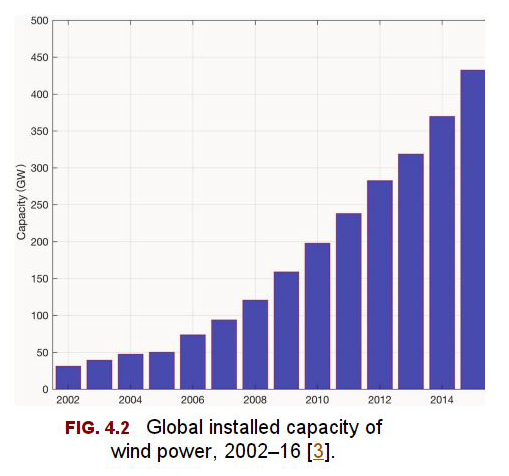
This is a new textbook. It’s interesting because it studies the Block Island Wind Farm and speaks in depth about Northeast offshore wind. I took some screenshots of the text book.
Wind energy is one of the fastest growing renewable energy sectors. Due to lower surface roughness, the wind resource is higher offshore.
Excerpts:

By Cate Rogers

Wind off the coast of Eastern Long Island is among the most consistent in America.
The SOUTH FORK WIND FARM’S 15 wind turbines 35 miles off Montauk will not be seen from land and will provide electricity to 70,000 households.
DO WE NEED MORE POWER?
Yes. We risk frequent brown outs during the peak summer season. Our energy grid cannot keep up with increasing demand. If power is not provided by wind turbines, use of dirty fossil fuels will continue to rise.
WHAT WILL THIS COST ME?
The average household monthly bill will go up by only about $1.50. The good news: because wind is renewable and free, the cost will be stabilized unlike the volatile cost of fossil fuels. This is a small short term cost for a long term solution.
WILL THIS HURT OUR FISHERMEN?
After listening to commercial fishermen, Bureau of Ocean Energy Management made sure that wind turbines and cable will avoid Cox’s Ledge, a valuable commercial fishing area. In fact, existing wind turbines off Block Island attract marine life to them, imitating an artificial reef.
THE NATIONAL & GLOBAL CASE FOR WIND ENERGY:
Scientific evidence continues to mount as to the urgency of reducing carbon emissions before it is too late:
SPECIES EXTINCTION
Due to Climate Change, one million species will face extinction and humans will suffer as a result unless action is taken. (United Nations report). The Audubon Society supports the use of wind power and reports the greatest threat to birdlife is Global Climate Change.
THE WORLD’S FISHERIES
are undergoing tremendous stress as the marine environment is altered by Climate Change. 93% of global warming heat is absorbed into our oceans, dramatically reducing marine life. Acidification of our surface waters is spelling extinction for some fish and shellfish. Eel grass forms the base of a highly productive marine food web. (NOAA). Locally, our commercial fisheries that depend on eel grass for spawning and protection, are threatened.
RISING SEA LEVELS
Caused by melting polar ice sheets, threaten coastal communities around the world — including our own.
VIOLENT WEATHER EVENTS
Climate Change is producing stronger storms and more intense hurricanes that are wreaking havoc on communities with high public and personal costs, including loss of life. Our towns are on the front line.
PUBLIC HEALTH
Warmer winters are dramatically increasing infectious disease-carrying insects as they
migrate north due to higher temperatures, causing untold costs and hardship. Locally, the
rise in Lyme disease and other tick-borne diseases is alarming.
By Cate Rogers

Our electricity currently comes from a mix of sources: Aging fossil fuel plants on Long Island, imported energy from “dirty” plants in neighboring regions and states,
and small local peaker plants in East Hampton and Southampton. These sources all contribute to air pollution and the Climate Crisis, and are subject to volatile “rate shock”. Doesn’t it make sense to begin the move to clean, renewable Offshore Wind Energy?
PLEASE CONNECT WITH US.
WE WOULD LOVE TO HEAR FROM YOU.
You can reach WIN WITH WIND
by email: weneedwindenergy@gmail.com
On Facebook: winwithwind
Web: www.winwithwind.org
on this blog: winwithwind.blog
“Coming together is a beginning; keeping together is progress; working together is
success.”
Edward Everett Hale

 WIN WITH WIND