Grand challenges in the science of wind energy

This review Appeared in the Journal “Science”, one of the premier Journals in the world.

Authored by Paul Veers1,*, and 28 other scientists.  Science  25 Oct 2019:
Vol. 366, Issue 6464, eaau2027
DOI: 10.1126/science.aau2027

I have copied the abstract and tried to sum up the salient points. Basically, the success of Wind (and Solar) energy, and the predicted growth of the industry, has led to new challenges. Innovations are needed to handle the predicted future demand for clean energy.

Abstract

Harvested by advanced technical systems honed over decades of research and development, wind energy has become a mainstream energy resource. However, continued innovation is needed to realize the potential of wind to serve the global demand for clean energy. Here, we outline three interdependent, cross-disciplinary grand challenges underpinning this research endeavor. The first is the need for a deeper understanding of the physics of atmospheric flow in the critical zone of plant operation. The second involves science and engineering of the largest dynamic, rotating machines in the world. The third encompasses optimization and control of fleets of wind plants working synergistically within the electricity grid. Addressing these challenges could enable wind power to provide as much as half of our global electricity needs and perhaps beyond.

Introduction:

Abundant, affordable energy in many forms has enabled notable human achievements, including modern food and transportation infrastructure. Broad-based access to affordable and clean energy will be critical to future human achievements and an elevated global standard of living. However, by 2050, the global population will reach an estimated 9.8 billion, up from ~7.6 billion in 2017 (1). Moreover, Bloomberg New Energy Finance (BNEF) estimates suggest that annual global electricity demand could exceed 38,000 terawatt-hours per year by 2050, up from ~25,000 terawatt-hours in 2017 (2). The demand for low- or no-carbon technologies for electricity is increasing, as is the need for electrifying other energy sectors, such as heating and cooling and transport (24). As a result of these two partially coupled megatrends, additional sources of low-cost, clean energy are experiencing increasing demand around the globe. With a broadly available resource and zero-cost fuel, as well as exceptionally low life-cycle pollutant emissions, wind energy has the potential to be a primary contributor to the growing clean energy needs of the global community.

During the past decade, the cost of three major electricity sources—wind power, solar power, and natural gas—has decreased substantially. Wind and solar are attractive because their low life-cycle emissions offer public health and broader environmental benefits. Leading energy forecasters such as consultancies, nongovernmental organizations, and major energy companies—and specifically BNEF, DNV GL, the International Energy Agency (IEA), and BP—anticipate continued price parity among all of these sources, which will likely result in combined wind and solar supplying between one- and two-thirds of the total electricity demand and wind-only shares accounting for one-quarter to one-third across the globe by 2050 (36). Tapping the potential terawatts of wind energy that could drive the economic realization of these forecasts and subsequently moving from hundreds of terawatt-hours per year to petawatt-hours per year from wind and solar resources could provide an array of further economic and environmental benefits to both local and global communities.

From a business perspective, at just over 51 gigawatts of new wind installations in 2018 (7) and more than half a terawatt of operating capacity, the global investment in wind energy is now ~$100 billion (U.S. dollars) per annum. The energy consultant DNV GL predicts that wind energy demand and the scale of deployment will grow by a factor of 10 by 2050, bringing the industry to the trillion-dollar scale (6) and positioning wind as one of the primary sources of the world’s electricity generation.

However, to remain economically attractive for investors and consumers, the cost of energy from wind must continue to decrease (8, 9). Moreover, as deployment of variable-output wind and solar generation infrastructure increases, new challenges surface related to the adequacy of generation capacity on a long-term basis and short-term balancing of the systems—both of which are critical to maintaining future grid system stability and reliability (1012).

A future in which wind energy contributes one-third to more than one-half of consumed electricity, and in which local levels of wind-derived power may exceed 100% of local demand, will require a paradigm shift in how we think about, develop, and manage the electric grid system (1014). The associated transformation of the power system in high-renewables scenarios will require simultaneous management of large quantities of weather-driven, variable-output generation as well as evolving and dynamic consumption patterns.

A key aspect of this future system is the availability of large quantities of near-zero marginal cost energy, albeit with uncertain timing. With abundant near-zero marginal cost energy, more flexibility in the overall electricity system will allow many different end users to access these “cheap” energy resources. Potential use cases for this energy could entail charging a large number of electric vehicles, providing inexpensive storage at different system sizes (consumer to industrial) and time scales (days to months), or channeling into chemicals or other manufactured products (sometimes referred to as “power-to-X” applications).

A second key aspect of this future system is the transition from an electric grid system centered on traditional synchronous generation power plants to one that is converter dominated (15). This latter paradigm reduces the physical inertia in the system currently provided by traditional power plants while increasing reliance on information and digital signals to maintain the robustness and power quality of the modern grid (12).

Here are some interesting figures from the this Review:
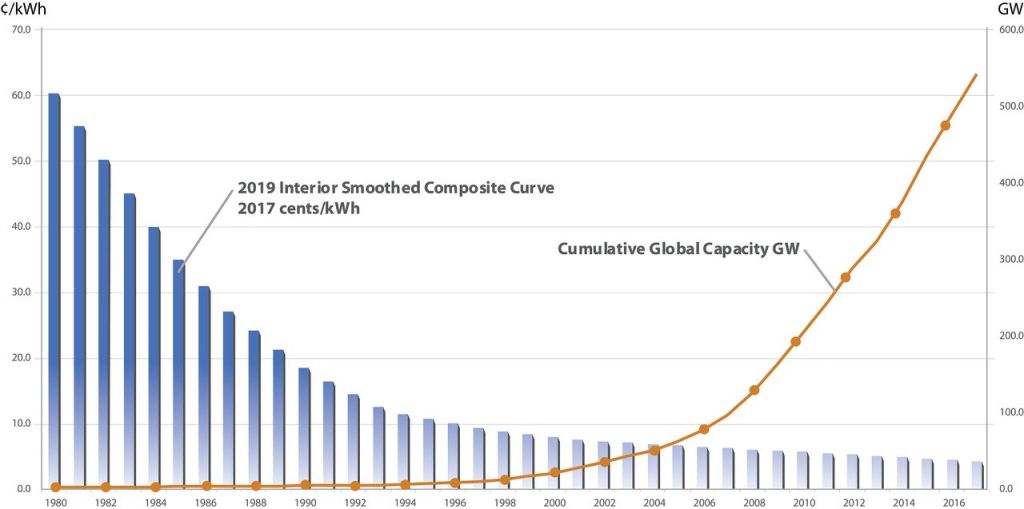
Fig. 1 Global cumulative installed capacity (in gigawatts) for wind energy and estimated levelized cost of energy (LCOE) for the U.S. interior region in cents per kilowatt-hour from 1980 to the present.Historical LCOE data are from (17) and (20) and have been verified for all but 5 years with the U.S. wind industry statistics database detailed in (17). LCOE data have been smoothed with a combination of polynomial best fit and linear interpolations to emphasize the long-term trends in wind energy costs. Historical installed capacity data are from the database detailed in (17), the Global Wind Energy Council, and the American Wind Energy Association.
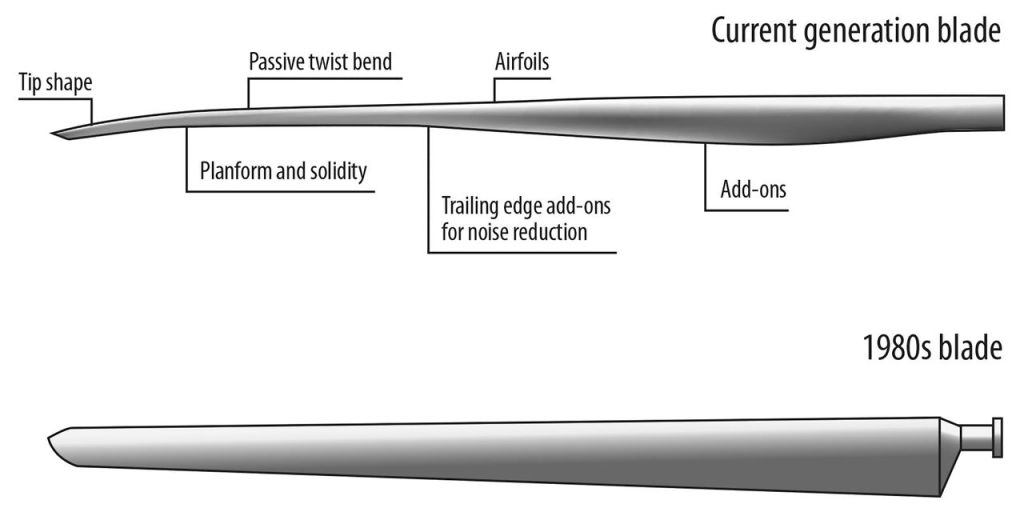
Fig. 2 Wind turbine blade innovation comparing a modern commercial blade (top) and a commercial blade from the mid-1980s (bottom) scaled to the same length.The modern blade is 90% lighter than the scaled 1980s technology.
NATIONAL RENEWABLE ENERGY LABORATORY (NREL) BASED ON A CONCEPT BY HENRIK STIESDAL AND KENNETH THOMSEN (SIEMENS GAMESA)
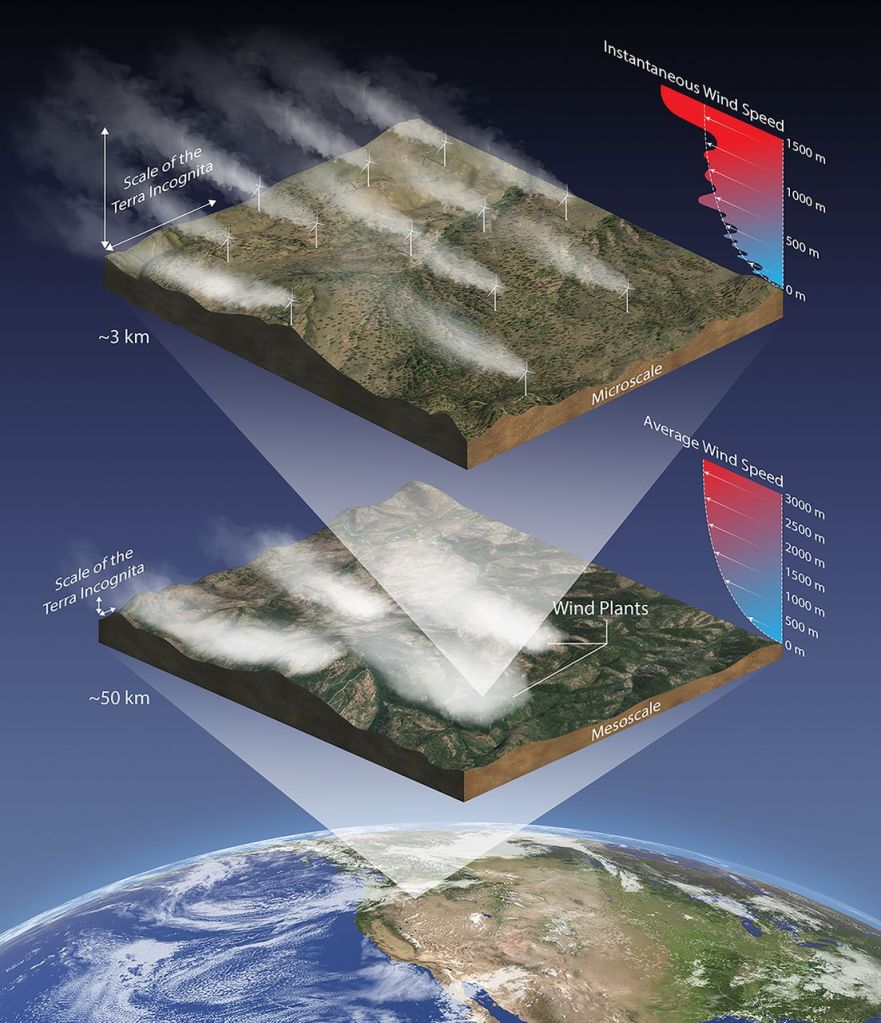
Fig. 3 Relevant wind power scales across space—from large-scale atmospheric effects in local weather at the mesoscale to inter- and intraplant flows and topography at the microscale.
ILLUSTRATION: BESIKI KAZAISHVILI, NREL
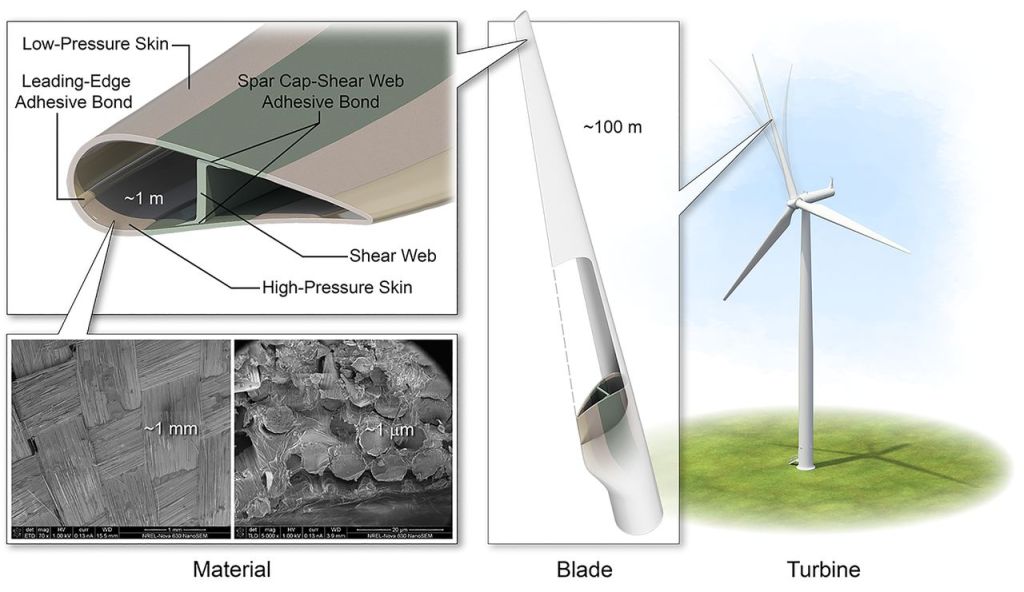
Fig. 4 Wind turbine blades are complex composite shell structures in which small-scale manufacturing flaws can grow because of the incessant turbulence-driven loading that can cause large-scale problems.
PHOTOS: NREL; ILLUSTRATION: BESIKI KAZAISHVILI, NREL
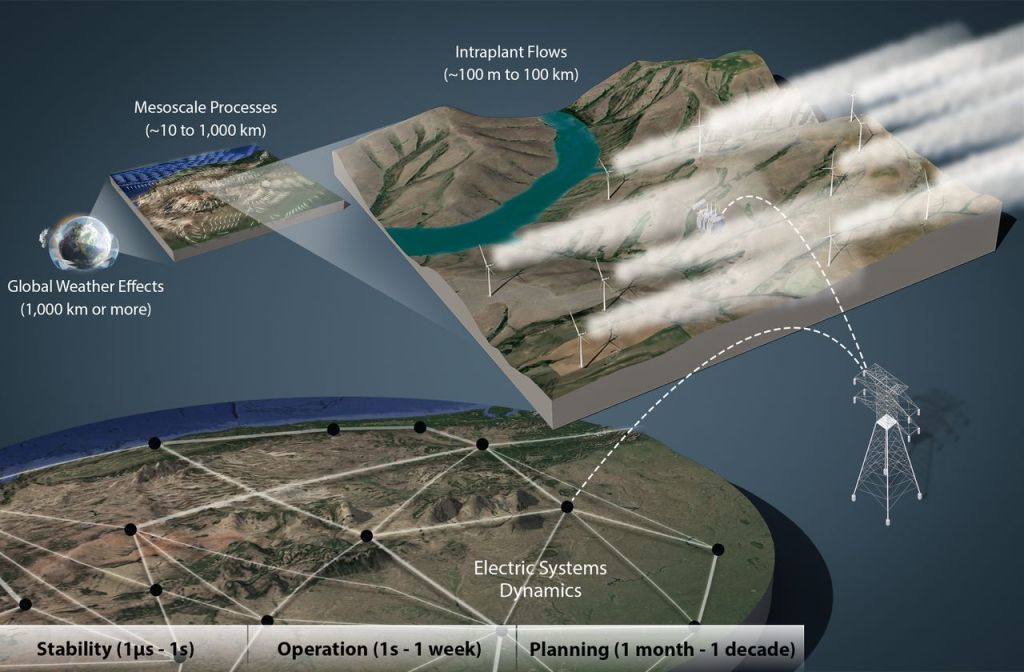
Fig. 5 Power generated by the weather-driven plant must connect to the electrical grid and support the stability, reliability, and operational needs on time scales ranging from microseconds (for managing disturbances) to decades (for long-term planning).
ILLUSTRATION: JOSH BAUER AND BESIKI KAZAISHVILI, NREL
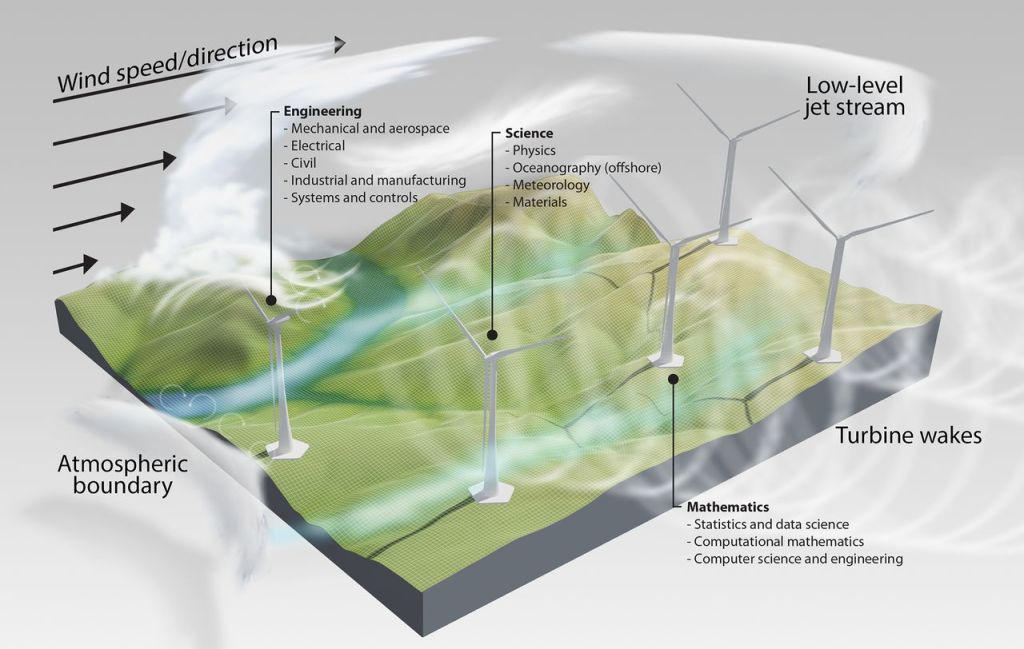
Fig. 6 A spectrum of science, engineering, and mathematics disciplines that, if integrated, can comprehensively address the grand challenges in wind energy science.
ILLUSTRATION: JOSH BAUER, NREL
Offshore windfarms ‘can provide more electricity than the world needs’

Supplies from turbines will prove to be the next great energy revolution, IEA predicts – International Energy Agency (IEA)

Jillian Ambrose Energy correspondent

In the Guardian, Fri 25 Oct 2019 04.23 EDT First published on Thu 24 Oct 2019 14.45 EDT

“Offshore wind currently provides just 0.3% of global power generation, but its potential is vast,” the IEA’s executive director, Fatih Birol, said.

The study predicts offshore wind generation will grow 15-fold to emerge as a $1tn (£780bn) industry in the next 20 years and will prove to be the next great energy revolution.

The IEA said earlier this week that global supplies of renewable electricity were growing faster than expected and could expand by 50% in the next five years, driven by a resurgence in solar energy. Offshore wind power would drive the world’s growth in clean power due to plummeting costs and new technological breakthroughs, including turbines close to the height of the Eiffel Tower and floating installations that can harness wind speeds further from the coast.

The next generation of floating turbines capable of operating further from the shore could generate enough energy to meet the world’s total electricity demand 11 times over in 2040, according to IEA estimates.

The report predicts that the EU’s offshore wind capacity will grow from almost 20 gigawatts today to nearly 130 gigawatts by 2040, and could reach 180 gigawatts with stronger climate commitments.

In China, the growth of offshore wind generation is likely to be even more rapid, the IEA said. Its offshore wind capacity is forecast to grow from 4 gigawatts to 110 gigawatts by 2040 or 170 gigawatts if it adopts tougher climate targets.

Birol said offshore wind would not only contribute to generating clean electricity, but could also offer a major opportunity in the production of hydrogen, which can be used instead of fossil fuel gas for heating and in heavy industry.

The process of making hydrogen from water uses huge amounts of electricity but abundant, cheap offshore wind power could help produce a low-cost, zero-carbon alternative to gas.

In the North Sea, energy companies are already planning to use the electricity generated by giant offshore windfarms to turn seawater into hydrogen on a floating “green hydrogen” project, backed by the UK government. The clean-burning gas could be pumped back to shore to heat millions of homes by the 2030s. The UK has committed to reaching net zero carbon emissions by 2050.

The overlap between the UK’s declining oil and gas industry and the burgeoning offshore wind sector could offer major economic benefits for the UK, Birol said.

“Offshore wind provides a huge new business portfolio for major engineering firms and established oil and gas companies which have a strong offshore production experience,” he said. “Our analysis shows that 40% of the work in offshore wind construction and maintenance has synergies with oil and gas practises.”

We have some news… about how we will respond to the escalating climate crisis – we will not stay quiet. This is the Guardian’s pledge: we will continue to give global heating, wildlife extinction and pollution the urgent attention and prominence they demand. The Guardian recognises the climate emergency as the defining issue of our times.

Our independence means we are free to investigate and challenge inaction by those in power. We will inform our readers about threats to the environment based on scientific facts, not driven by commercial or political interests. And we have made several important changes to our style guide to ensure the language we use accurately reflects the environmental catastrophe.

The Guardian believes that the problems we face on the climate crisis are systemic and that fundamental societal change is needed. We will keep reporting on the efforts of individuals and communities around the world who are fearlessly taking a stand for future generations and the preservation of human life on earth. We want their stories to inspire hope. We will also report back on our own progress as an organisation, as we take important steps to address our impact on the environment.

The Guardian made a choice: to keep our journalism open to all. We do not have a paywall because we believe everyone deserves access to factual information, regardless of where they live or what they can afford.

We hope you will consider supporting the Guardian’s open, independent reporting today. Every contribution from our readers, however big or small, is so valuable

An introduction to the state of wind power in the U.S.

Yale Climate Connections

Rural and often conservative states are leading the way in harnessing the wind.

By Philip Warburg; Monday, October 7, 2019
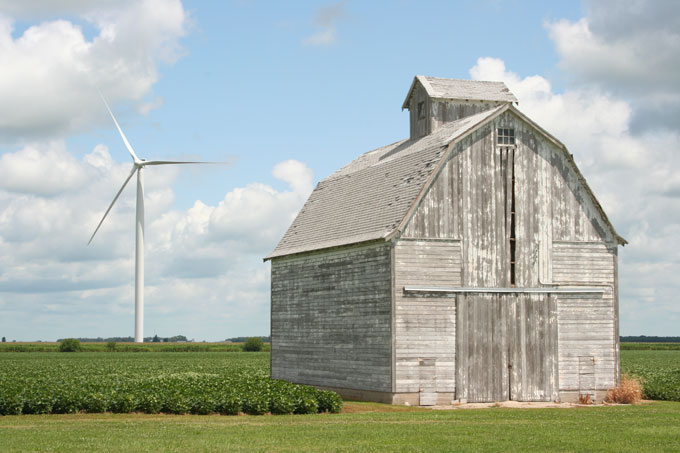
Farm and wind turbine
The Meadow Lake Wind Farm, northwest of Indianapolis, generates enough power for 220,000 average Indiana homes. (Photo credit: Philip Warburg)

Advances in technology, improved economics, and broad political support are making wind power a formidable twenty-first century energy resource. Top-ranking Denmark draws 41% of its electricity from wind; Ireland follows with 28%; the European Union as a whole gets 14% of its power from wind.

America’s wind farms currently produce 6.6% of the nation’s electricity. As a share of total power generation, that may sound relatively modest, but the U.S. ranks second only to China in the quantity of power-generating capacity that comes from wind. Moreover, the U.S. has scarcely begun to tap its vast wind power potential. On land, U.S. wind resources are capable of yielding about nine times the nation’s power needs. Offshore wind – wholly unexploited to date – could meet nearly twice the nation’s electricity demand.

Looking ahead, the Department of Energy has prepared a scenario for 35% wind reliance by 2050. While that level of wind generation sounds like major progress, it may be substantially less than is needed for renewable energy resources to be the primary drivers of a net-zero carbon U.S. economy.

Wind power’s evolution

Wind power has served various purposes in America since colonial times, but it first became available as a source of electricity in the early 20th century, when modestly scaled wind chargers supplied power to thousands of American homesteads and farm operations. Soon, however, a built-out grid brought centrally generated electricity to the nation’s rural areas, leaving little room for small-scale wind. It wasn’t until the mid-1970s that the Arab oil embargo and a growing interest in renewable energy gave rise to a second wave of American wind power.

In 1978, the Public Utility Regulatory Policies Act (PURPA) broke open the U.S. power market by requiring utilities to buy electricity from independent companies so long as they could generate electricity at less than the “avoided cost” of new utility-generated power. That law paved the way for America’s first commercial wind farm developers. A federal investment tax credit gave wind farms an additional push, particularly in California where a matching state tax credit earned renewable energy investors a 50% combined tax break.

These incentives created a super-heated climate for eager wind energy entrepreneurs. Often relying on minimally tested technology, California’s early wind farms experienced a high rate of mechanical and structural failure, supplying ample fodder to politicians who much preferred mining domestic coal and drilling for oil and gas.

The federal investment tax credit lapsed in 1985 and the California tax credit ratcheted down over the subsequent two years, slowing commitments to new wind projects. A federal incentive for wind was revived in 1992, but this time it was reformulated as a production tax credit that rewarded the actual generation of electricity. Hampered by repeated delays in reauthorization, the federal production tax credit has nevertheless been a key catalyst to wind power’s ascent, reinforced by widely adopted state-level renewable electricity standards that require utilities to increase their reliance on wind and other sources of renewable energy.

The scaling up and declining cost of wind power

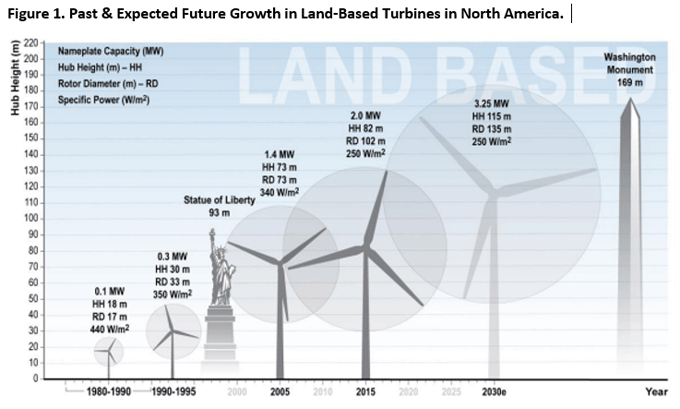
The average wind turbine today is nearly three times taller than turbines built in the early 1990s. [See Figure 1.] This allows modern wind farms to tap the stronger, more constant winds that prevail at higher altitudes. Because wind power increases as the cube of wind speed, the gains from taller towers are particularly momentous.

A further boost to output comes from development and use of much larger rotors. Applying the formula for the area of a circle (A= π r2), an increase in blade length (i.e. rotor radius) translates into a disproportionate expansion of the rotor’s “swept area,” a key to determining the amount of wind that is captured and converted into electricity.

Figure 1
Source: Berkeley Lab, 2016

While wind turbines have grown dramatically in size, the cost of building and operating U.S. wind farms has dropped in recent years, making them now fully competitive with the two other leading sources of new power generation: solar photovoltaics and combined cycle gas. According to Lazard, the levelized cost of land-based wind power ranges from $29 to $56 per megawatt-hour; photovoltaics cost from $36 to $46 per megawatt-hour; and combined cycle gas runs from $41 to $74 per megawatt-hour. Nuclear power is much more expensive at $112 to $189 per megawatt-hour.

The geopolitics of wind

As a non-carbon-emitting technology, wind power has a big environmental advantage over its leading fossil fuel competitors. Onshore and offshore wind has a life cycle carbon footprint of 20 grams or less of CO2 equivalent per kilowatt-hour. The “cleanest” natural gas power plants – those that use combined cycle technology – produce more than 400 grams of CO2 equivalent per kilowatt-hour. Supercritical coal plants – the least polluting in the industry – generate close to 800 grams of CO2 equivalent per kilowatt-hour.

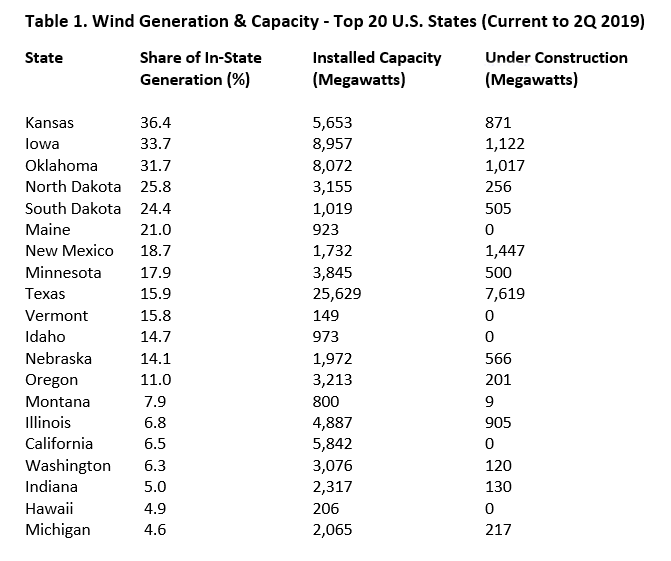
While attractive to many who see climate change as a real and immediate threat, wind power has developed much of its momentum in relatively conservative rural states [see Table 1]. In 2018, 13 states in the nation’s interior region accounted for more than 80% of new wind capacity additions.

Table 1
Source: American Wind Energy Association, 2019

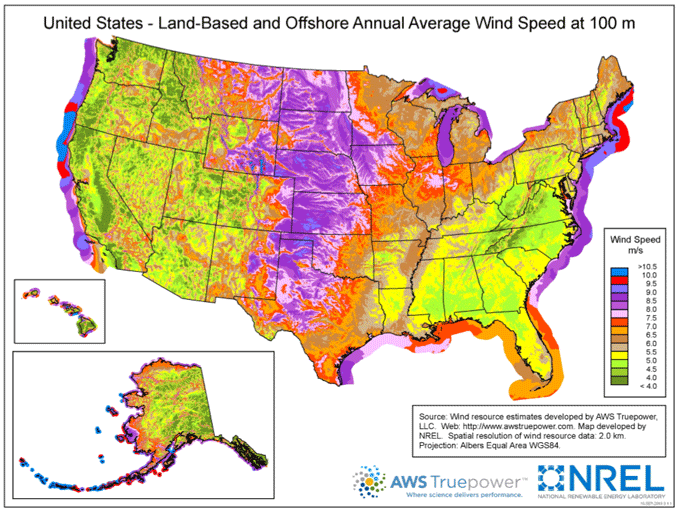
Robust and relatively steady winds in the so-called Wind Belt, from Texas on up through the Dakotas, partially account for the heartland’s heavy investment in wind [see map]. Economics are also at play. Not only are many of the 111,000 American wind power jobs located in rural areas, but substantial financial benefits accrue to farmers and ranchers who lease out small sections of their lands to wind developers. Wind farm-generated tax revenues have also aided many cash-strapped rural communities.

NREL image
Source: National Renewable Energy Laboratory, AWS Truepower

Watching out for birds and bats

Estimates vary, but hundreds of thousands of birds per year are thought to be killed by wind turbines, and those numbers are expected to rise as wind power’s use expands.

The U.S. Fish and Wildlife Service has an Avian Radar Project that helps wind developers identify and steer clear of major bird migratory corridors when siting new wind farms. At some operating wind farms where raptors and other vulnerable bird species may be present, specialized detection equipment and human monitors can halt turbines as birds approach.

While bird fatalities are certainly cause for concern, wind energy proponents urge that they be viewed in perspective. The U.S. Fish and Wildlife Service estimates that 365 to 988 million birds die each year by crashing into building windows, and 89 to 340 million die in collisions with cars. Communication towers and electric utility lines cause millions of additional bird deaths annually. And the ravages of climate change caused by fossil fuel burning will wipe out vastly greater numbers of birds as entire ecosystems are disrupted.

Efforts are also being made to minimize harm to bats living near wind farms. Because bats generally fly in low winds hunting for insects, studies have shown that their mortality rates can be minimized by curtailing wind operations during these times – precisely when there are limited economic gains from keeping turbines running. The Beech Ridge Wind Energy Project, located in a wooded area of West Virginia, has been particularly engaged in these curtailment efforts.

Wind noise

Another commonly expressed concern involves noise resulting from wind power, with neighbors’ complaints ranging from irritability, headaches, and insomnia caused by audible sound to more tenuous claims of inner ear and sense of balance disturbances attributed to ultra-low frequency infrasound. While the transmission of turbine-generated sound can vary with topography and weather conditions, setting a minimum setback for wind turbines from the nearest inhabited buildings and outdoor public spaces is one important step that state and local governing bodies can take to protect wind farm neighbors and reduce public resistance to proposed projects.

Offshore wind – the next frontier

Though well advanced in several European nations, U.S. offshore wind got off to an unfortunate start with New England’s hotly contested Cape Wind project. Proposed for shallow waters near upscale vacation communities on Cape Cod, Martha’s Vineyard, and Nantucket, Cape Wind met with vigorous opposition. Substantially funded by fossil fuel interests, opponents objected to the project’s high cost to ratepayers, but the anticipated visual impact of turbines on Nantucket Sound drew particular hostility. Backers abandoned Cape Wind in 2018.

There’s new and increasing hope for U.S. offshore wind, with numerous federal leases opening up large expanses of ocean acreage from New England down through the mid-Atlantic. Technology advances, including floating turbines, make it possible to place wind farms in deeper waters, farther from populated coastal areas. Equally important, much lower project costs now make offshore wind a realistic competitor with other sources of power generation. Public concern and official analyses now focus on balancing wind development with fisheries and marine mammal protection and with navigational safety.

The way forward

As U.S. reliance on wind power grows, there is an increased need to build enough energy storage and demand response capability to absorb surplus power when it’s generated and adjust to shortfalls when they occur. Modernized and expanded transmission also will be required, to manage the flow of electricity from diverse energy resources across broad geographical areas. Prioritizing these investments will be essential if wind is to meet its potential as a bulwark against runaway U.S. greenhouse gas emissions.

AUTHOR
Philip Warburg, an environmental lawyer and former president of the Conservation Law Foundation, is the author of Harvest the Wind: America’s Journey to Jobs, Energy Independence, and Climate Stability. On twitter: @pwarburg.

Filed under: Philip Warburg

Trump’s Windmill Hatred

The following article appeared verbatim in The New York Post (not exactly a left wing rag).

Donald Trump’s windmill hatred is a worry for booming industry

By Associated Press, September 30, 2019

BLOCK ISLAND, R.I. — The winds are blowing fair for America’s wind power industry, making it one of the fastest-growing US energy sources.

Land-based turbines are rising by the thousands across America, from the remote Texas plains to farm towns of Iowa. And the US wind boom now is expanding offshore, with big corporations planning $70 billion in investment for the country’s first utility-scale offshore wind farms.

“We have been blessed to have it,” says Polly McMahon, a 13th-generation resident of Block Island, where a pioneering offshore wind farm replaced the island’s dirty and erratic diesel-fired power plant in 2016. “I hope other people are blessed too.”

But there’s an issue. And it’s a big one. President Donald Trump hates wind turbines.

He’s called them “disgusting” and “ugly” and “stupid,” denouncing them in hundreds of anti-wind tweets and public comments dating back more than a decade, when he tried and failed to block a wind farm near his Scottish golf course.

And those turbine blades. “They say the noise causes cancer,” Trump told a Republican crowd last spring, in a claim immediately rejected by the American Cancer Society.

Now, wind industry leaders and supporters fear that the federal government, under Trump, may be pulling back from what had been years of encouragement for climate-friendly wind.

The Interior Department surprised and alarmed wind industry supporters in August, when the agency unexpectedly announced it was withholding approval for the country’s first utility-scale offshore wind project, a $2.8 billion complex of 84 giant turbines. Slated for building 15 miles (24 kilometers) off Martha’s Vineyard, Massachusetts. Vineyard Wind has a brisk 2022 target for starting operations. Its Danish-Spanish partners already have contracts to supply Massachusetts electric utilities.

Investors backing more than a dozen other big wind farms are lined up to follow Vineyard Wind with offshore wind projects of their own. Shell’s renewable-energy offshoot is among the businesses ponying up for federal leases, at bids of more than $100 million, for offshore wind farm sites.

The Interior Department cited the surge in corporate interest for offshore wind projects in saying it wanted more study before moving forward. It directed Vineyard Wind to research the overall impact of the East Coast’s planned wind boom.

Interior Department spokesman Nicholas Goodwin said offshore energy remains “an important component” in the Trump administration’s energy strategy. But the strategy includes “ensuring activities are safe and environmentally responsible,” Goodwin said in a statement.

Wind power now provides a third or more of the electricity generated in some Southwest and Midwest states. And New York, New Jersey and other Eastern states already are joining Massachusetts in planning for wind-generated electricity.

Along with the US shale oil boom, the rise in wind and solar is helping cushion oil supply shocks like the recent attack on Saudi oil facilities.

But the Interior Department’s pause on the Vineyard Wind project sent a chill through many of the backers of the offshore wind boom. Critics contrast it with the Republican administration’s moves to open up offshore and Arctic areas to oil and gas development, despite strong environmental concerns.

“That I think is sort of a new bar,” for the federal government to require developers to assess the impact of not just their projects but everyone’s, said Stephanie McClellan, a researcher and director of the Special Initiative on Offshore Wind at the University of Delaware. “That worries everybody.”

Thomas Brostrom, head of US operations for Denmark’s global offshore wind giant Orsted and operator of the pioneering Block Island wind farm, said that “the last three, four years have seen unbelievable, explosive growth, much more than we could have really hoped for,” in the US, compared to Europe’s already established wind power industry.

Given all the projects in development, “we hope that this is a speed bump, and certainly not a roadblock,” Brostrom said.

Wind power and the public perception of it have changed since America’s first proposed big offshore wind project, Cape Wind off Cape Cod, Massachusetts, died an agonizing 16-year death. Koch and Kennedy families alike, along with other coastal residents, reviled Cape Wind as a potential bird-killing eyesore in their ocean views.

But technological advances since then mean wind turbines can rise much farther offshore, mostly out of sight, and produce energy more efficiently and competitively. Climate change — and the damage it will do these same coastal communities — also has many looking at wind differently now.

Federal fisheries officials have been among the main bloc calling for more study, saying they need to know more about the impacts on ocean life. Some fishing groups still fear their nets will tangle in the massive turbines, although Vineyard Wind’s offer to pay millions of dollars to offset any harm to commercial fishing won the support of others. At least one Cape Cod town council also withheld support.

A rally for Vineyard Wind after the Interior Department announced its pause drew local Chamber of Commerce leaders and many other prominent locals. Massachusetts’ Republican governor, Charlie Baker, has been traveling to Washington and calling Interior Secretary David Bernhardt to try to win his support.

At Cape Cod Community College in West Barnstable, instructor Chris Powicki’s Offshore Wind 101 classes and workshop have drawn nuclear and marina workers, engineers, young people and others. People are hoping wind will provide the kind of good-paying professions and trades they need to afford to stay here, Powicki says.

“Cape Cod has always been at the end of the energy supply line, or at least ever since we lost our dominance with the whale oil industry” after the 19th century, the community college instructor said. “So this is an opportunity for Cape Cod to generate its own energy.”

On land, the wind boom already is well established. By next year, 9% of the country’s electricity is expected to come from wind power, according to the US Energy Information Administration. The wind industry already claims 114,000 jobs, more than twice the number of jobs remaining in US coal mining, which is losing out in competition against cleaner, cheaper energy sources despite the Trump administration’s backing of coal.

The Trump animosity to wind power has gone beyond words in some states, especially in Ohio. A Trump campaign official was active this summer in winning a state ratepayer subsidy for coal and nuclear that also led to cutting state incentives for wind and solar.

But despite the steady gales of condemnation from the country’s wind-hater in chief, wind is booming most strongly in states that voted for Trump.

Then-Texas Gov. Rick Perry, now Trump’s energy secretary, pushed his state to one of the current top-four wind power states, along with Oklahoma, Kansas and Iowa.

In Iowa, home to nearly 4,700 turbines that provided a third of the state’s electricity last year, wind’s popularity is such that Republican Sen. Chuck Grassley had a drone film him as he sat, grinning, atop one of the country’s biggest wind turbines.

Grassley had no patience for Trump’s claim in April that wind turbines like Iowa’s beloved ones could cause cancer.

“Idiotic,” Grassley said then.

On the East Coast, many developers and supporters of offshore wind politely demur when asked about Trump’s wind-hating tweets and comments.

But not on Block Island.

“We’re very fortunate that we got it. Very fortunate. It’s helped us,” McMahon, the retiree on Block Island, said of wind energy. “And don’t worry about the president. He’s not a nice man.”

Our Planet is Gasping for Breath

Appeared yesterday in the EAST HAMPTON STAR.

The Final Inning
Springs
August 30, 2019

Dear David,

Baseball fans like to check the box scores. Unlike people, the numbers never lie. As a fan of the planet earth, I like to check out the NASA website Global Climate Change, climate.nasa.gov/vital-signs/carbon-dioxide.

The June 2019 box score for earth is depressing: 412 parts per million of carbon dioxide in the atmosphere, three parts higher than one year ago. For those who may not be avid earth fans, CO2 is the primary greenhouse gas driving climate change. A graph on the NASA website shows that it never exceeded 300 parts per million in 400,000 years of earth’s history. Then we started pumping fossil fuel emissions (CO2) into the air, and it has been rising steadily since. If earth were a baseball team, fans would be clamoring for the manager’s head, lambasting the owner for being too cheap to pay for decent pitching.

The self-appointed manager of the Wainscott opponents of clean wind energy is Simon Kinsella, who claims to be an earth fan, but he thinks a buried cable in his neighborhood is too big a price to pay to improve our chances of winning against climate change. Winning is not guaranteed. In fact, all indications are that humanity is already assured a grim century.

Scientists now project that we must reduce fossil emissions by 45 percent in 11 years to avoid dire consequences. Generalize from resistance to clean energy, like what we see from Mr. Kinsella, and one must conclude that there is scant chance of reaching that goal. So it is bad news indeed that we are still turning earth’s thermostat up. And it is puzzling that Mr. Kinsella persists in telling his team they need not do anything different. They should not accept even a small inconvenience. And it is galling that some residents blithely follow this pied piper of petrochemicals.

Pay no attention to forest fires now raging north of the Arctic Circle in Alaska, Greenland, Siberia, and the Amazon, releasing an unexpected rush of additional CO2 that scientists didn’t count in their calculations. Simon says ignore the 197 billion tons of ice melted from Greenland in the month of July 2019. Ignore 109 degrees in Paris. Mr. Kinsella must feel that we have plenty of time to resist any local disruption and force others to bear the burden.

But the box score scrupulously kept by NASA scientists is crystal clear. We are in the final inning in which we can do anything to forestall the coming chaos. Pay attention, kids. You may be privileged to live at a great inflection point in planetary history, the point at which we humans, through scientific illiteracy, oblivious self-interest, and greed, doom ourselves to be just another dead end on the merciless map of evolution.

Simon might tell you it isn’t him; it’s Donald Trump or Mitch McConnell. But Trump and McConnell can’t do it alone. They need thousands of Si Kinsellas, whether paid lobbyists or useful idiots, on the front lines fighting every local effort to build the infrastructure for clean energy, saying, “Wait! Don’t be rash! WE don’t need to sacrifice even a little of our bubble of comfort.”

Recently Simon sent an email to 800 town residents, impugning the integrity of Gordian Raacke, a man who for 26 years has been fighting for renewable energy in all of its forms. This email was riddled with false statements. Suggesting that solar and microgrid can render Deepwater unnecessary, he appends a document called “Community Microgrid Project,” and suggests this was a town solution to climate change that was diverted by Mr. Raacke. In fact, Mr. Raacke fought hard for this type of project, but it failed for economic reasons to gain state approval. I suppose Kinsella figured nobody would read it, because it actually is an unsolicited study that calls for 15 megawatts of solar. Deepwater is for 130 megawatts. This is like suggesting the new batboy renders the home-run hitter unnecessary.

I don’t know anybody supporting the wind farm who is opposed to microgrids and solar. We are for both. If we are to achieve net zero, even the wind farm is not enough. But we are in the midst of a climate emergency. The wind farm is shovel ready, with private money willing and eager to build it at negligible cost to ratepayers. The microgrid and solar solution is at this point a flying-horse fantasy, unplanned, unsited, and unfunded, and is simply being used as a distraction by those, like Mr. Kinsella, who resist even the smallest inconvenience in their neighborhood in the town’s effort to reduce its carbon footprint.

I urge the signers of Kinsella’s petitions to visit the NASA website and read the box score. Tell him to find another hobby, if it is a hobby. Maybe it’s a profession. We don’t know who is paying for the phalanx of lawyers and engineers on his payroll. A suspicious sort might wonder if fossil-fuel money is involved, but I suppose it could be just homegrown ignorance.

Our planet is gasping for breath. Don’t be fooled by fantasies.

DON MATHESON

Are Offshore Wind Developers Responsible For Fishing Gear Damaged In A Wind Farm?

The short answer is YES. It is the law. South Coast Reporter Nadine Sebai has been extensively covering the issue.

You can ask her direct questions here: Fill out this form.

In spite of the fears voiced by some fishermen, its interesting that major offshore cables have been in existence in the Long Island sound and the New York Harbor for over 20 years. Initial concerns about dangers to the fishing and shell fishing industries in the relevant areas have not materialized. Its strange that no one talks about this… Check my earlier post on this story.

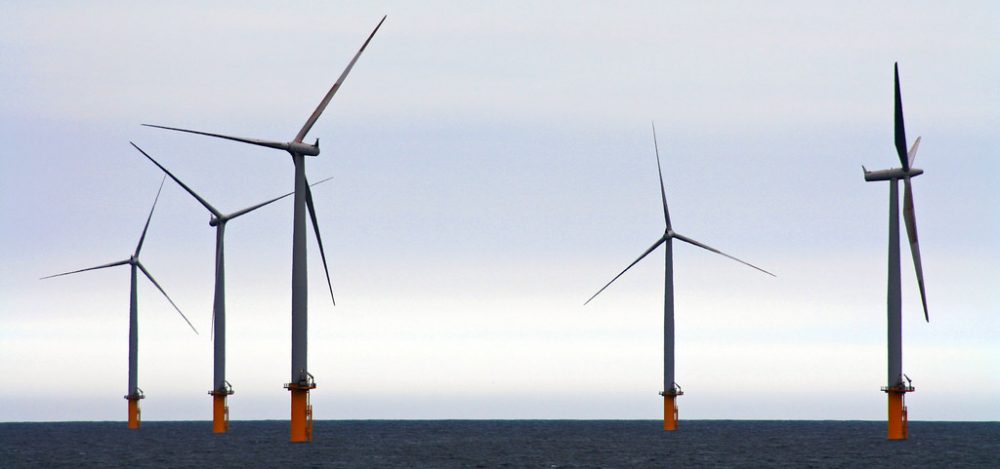
South Fork Wind Farm

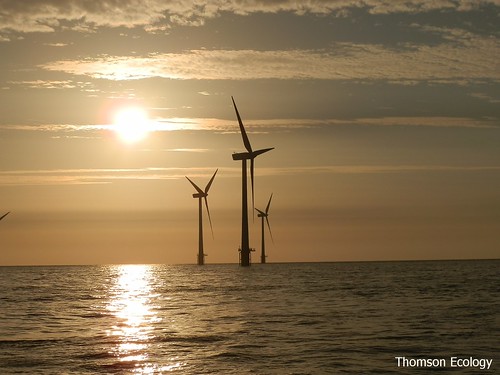
Offshore wind farm
From https://www.flickr.com/photos/thomsonecology/15079751399/

Submitted by Alice Tepper Marlin. (letter to the editor of the EH Star, July 2019)

The wind farm proposed to be sited out of sight, 35 miles off our shores, can make a significant contribution to slowing the climate change that so threatens our beautiful seaside community and all life on our precious, unique planet. It is crucial to our town commitment to be powered 100% by renewables by 2030.

To my consternation, opposition is being skillfully fomented by a few individuals who, for various self-interested reasons, loudly promote misinformation and even disinformation about the project and the company behind it, sowing unwarranted fear and distrust.

The brouhaha is over the onshore route of the transmission line carrying the wind-generated electricity from the turbines to the East Hampton substation. The entire line will be under ground. I have seen the equivalent on Block Island, and it is hardly noticeable. All you can see are occasional manhole covers.

Yes, there would be a few months of wintertime construction for installation, but the route from Wainscott is only four miles long and half of it is in the railroad corridor. So this disruption is in no way a big deal. Just a few months ago, ten miles of water main were installed in Wainscott, and not a peep was heard to challenge it.

What about Orsted? Orsted is a Danish renewable energy company and a global leader in offshore wind. Its new partner, Eversource, is a premier transmission builder with 100 years of experience providing energy in the Northeast. Orsted supplies over 25% of the world’s wind energy capacity. It has experience successfully building thousands of offshore turbines in Europe. Fishermen in England, The Netherlands, and France report positively, they say that the fish love these artificial reefs. If these were oil rigs, there would be not only climate damage but also occasional spills killing thousands of marine animals. What harm can we even imagine from a wind spill? In 2018, Orsted won aN award for the most socially responsible companies in the world.

Independent of East Hampton’s decisions, there will be two dozen government reviews before construction can begin. These will provide detailed environmental and other reviews at a technical level above and beyond what one might reasonably expect at the local level. Numerous top environmental groups are participating in the process. In addition, East Hampton has the right to submit all our questions and concerns in these processes. The town Board has already filed a submission.

The South Fork Wind Farm will be able to generate enough power for 70,000 South fork homes.

Our region has the fastest growth rate for electricity use on Long Island. Forecasts indicate that that all the electricity generated by the South Fork wind farm will be required in our local region But even if that proves not to be the case, what portion serves homes and businesses here and what portion serves homes elsewhere matters not a bit to its lessening of global warming and of the acidification of our waters. Acidification from burning fossil fuels has already been a factor in driving the lobsters north and harms all life in the ocean.

We as citizens have a duty not only to our local community but also to the nation.

Let’s think globally and act locally: let our Trustees and Board members know that you want to be counted and will welcome the wind farm.

Alice Tepper Marlin

Support for South Fork Wind Farm

East Hampton, NY

First there is this report “Labor, Environmental Organizations, and Long Island Residents Voice Strong Support for Critical Offshore Wind Development” released by the Sierra Club.

…and then this very poignant personal letter submitted at the PSC hearing on June 11th in East Hampton:

June 11, 2019

My name is Michael Hansen. I live in Wainscott.

Today is my wedding anniversary.

But I am here today instead… (my wife understands) because I am acutely aware that we are in a climate crisis. And it’s happening right now. It’s happening on Long Island. It’s happening in the Township of East Hampton.

1.   The docks at Shelter Island need to be raised because of a rising sea level.

2.   We are paying to shore up the infrastructure in Montauk because today’s “typical nor’easter,” is not typical at all.

But the opposition to wind power on the East End wants you to know, and they have said it many times, that they are, “for renewable energy, they are for solar power, they are for wind power… but not now, it’s too expensive, somewhere else, not in my backyard.”

We are paying for climate change right now. Our tax dollars are going to those docks in Montauk. Today.  

We are in a climate crisis and I am here today to speak for my children. My daughter is eight and my son is six.

My family has been on the East End for over three hundred years—as I am sure many of the families in this room have been—and my family and yours will continue to live here. And a wind farm, that is part of a comprehensive plan, is key to our children’s future.

A final word on Wainscott. The cable landing should be there. It will be least disruptive to East Hampton Town. And, ya know, Wainscott is tough. We can take it. We endured Suffolk County Water digging up our roads to provide us with clean water.

We can endure one lane of digging for clean energy.

Why all the fuss?

This is a cross section (a real piece) of the existing Block Island cable for their wind farm, consisting of 5 wind turbines that produce all the energy for the island with surplus energy for the state of Rhode Island. It is on my kitchen table. It measures 7 inches in diameter. It is similar to the cable that will bring energy from the South Fork Wind farm ashore.

“Carbon-free New York by 2040” is the overriding goal. Period.

If the urgency of achieving this goal is not apparent to any readers, just look at the most recent local news: “Higher tides force Shelter Island Ferry to rebuild ramps” This is a very real cost of sea level rise here on the South Fork! Check it out via Newsday.com.

And this is just the beginning.

On the other side of the issue we have loud opponents of the South Fork wind farm:

1) wealthy homeowners, with mansions on the Wainscott beach, who oppose any cable coming ashore in their vicinity, clearly a case of NIMBY

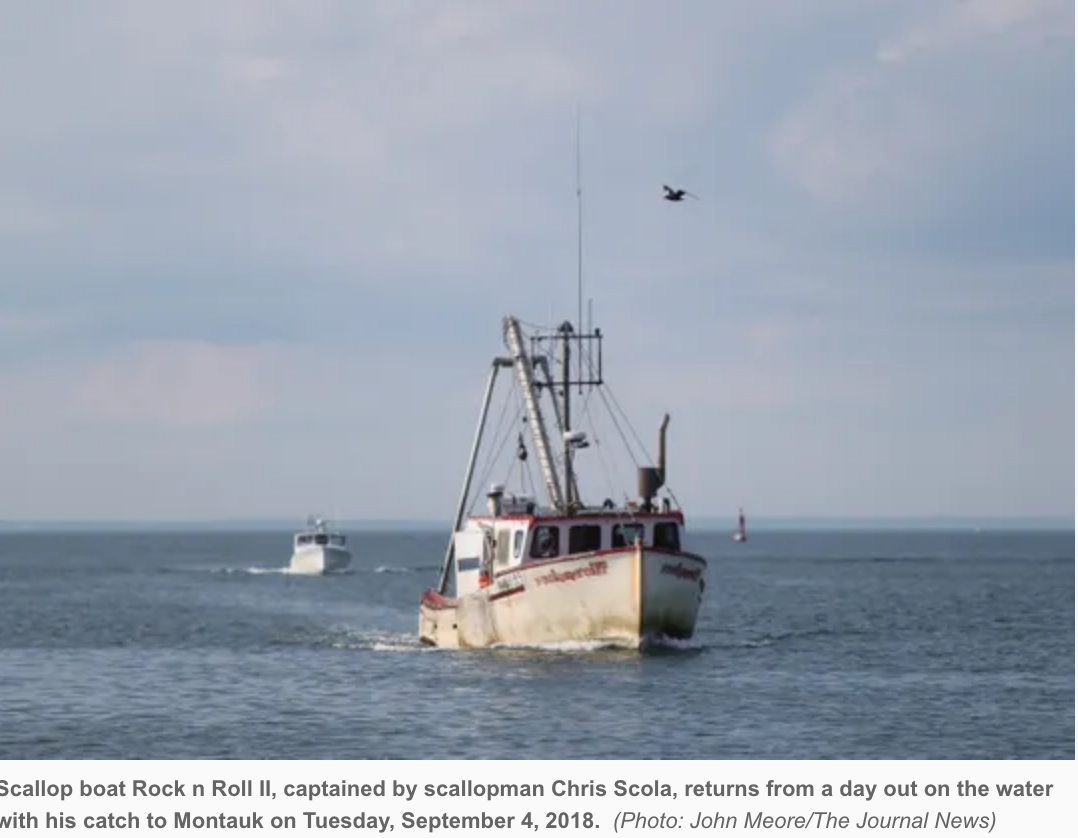
2) fishermen that have been whipped up with scare tactics.  I note that there are only 2 commercial fishing boats out of Montauk that fish in the Southfork wind farm area (OCS-A 0486, near Cox Ledge) which is closer to Rhode Island and Martha’s Vineyard than to Montauk.  From Montauk it takes 5 hours to get there by boat and 5 hours back.

For all those worried about a disruptive cable running under the sea bed and coming ashore somewhere, I would point out that a larger electric cable already feeds power in to Long Island coming all the way from New Jersey.  This dates back to 2007!  Like a giant extension cord, this transmission cable, named Neptune, stretches 50 miles underwater from Sayreville, N.J., comes ashore at Jones beach and has been plugged into Long Island for all these years without any nefarious effects on, or off shore. It is a 10″ cable and provides 660 megawatts.  

Likewise LIPA imports power from New England on the 330-megawatt Cross Sound Cable, which runs underwater from Connecticut. Two older cables, the 600-megawatt Y49 cable and the 599-megawatt Y50 cable, also run under the Sound to the Island.

Initial concerns about the effects on the shell fish industry were apparently not a problem over all these years.

Read more here: