Unknown's avatar

About D. Posnett MD

Emeritus Prof. of Medicine, Weill Cornell Medical College

Anglers Sign-on Letter for Responsible Offshore Wind

Ms. Amanda Lefton
Director, Bureau of Ocean Energy Management
45600 Woodland Road
Sterling, VA 20166

Re: Notice of Intent to Prepare an Environmental Impact Statement for Ocean Wind, LLC’s Proposed Wind Energy Facility Offshore New Jersey

On behalf of the undersigned individuals, businesses, organizations and the thousands of recreational anglers we represent across the northeast region, we submit the following comments on the Bureau of Ocean Energy Management’s (BOEM) Notice of Intent (NOI) to prepare an Environmental Impact Statement (EIS) regarding the Ocean Wind 1,100-megawatt offshore wind energy project that is a joint venture between Ørsted and PSEG.

Governor Murphy has made New Jersey a national leader in offshore wind with a goal of deploying 7,500 megawatts of responsibly developed offshore wind by 2035, enough to power 3.75 million homes. New Jersey’s offshore wind strategic plan states, “New Jersey must develop offshore wind in a manner that maintains and protects robust commercial and recreational fishing, while recognizing that the environmental benefits of offshore wind and new economic opportunities it brings also have the potential to support these industries.” The EIS is a critical step to achieve this goal, and we support projects moving through a robust environmental review process that ensures responsible development is achieved every step of the way.

As recreational anglers, we recognize the potential benefits of offshore wind power and believe it is possible for turbine development to peacefully coexist with and even improve fishing in the Atlantic, provided project developers and government agencies abide by three clear principles as articulated by Anglers for Offshore Wind Power, listed below.

Anglers Principles for Responsible Offshore Wind Power Development:

Access: Recreational anglers must be able to fish up to the base of the turbine foundations to take advantage of the new habitat that will be created by offshore wind power development. We understand that access may be limited during construction.

Public Input: Recreational anglers must be engaged early in the planning process for offshore wind power development. Clearly communicated opportunities to provide input on siting, permitting, access, and other issues can avoid future conflicts.

Science: Fisheries research before, during, and after wind turbine construction is essential for monitoring impacts to species of interest to recreational anglers. Study results should be publicly available and regularly communicated to our community.

Upon review of the Construction and Operations Plan, and guided by the principles listed above, we have prepared the following recommendations for inclusion in the Draft Environmental Impact Statement, guided by each of our principles.

Access:

By far, the number one issue of concern to the recreational fishing community is the potential loss of access to the very productive offshore fisheries that occupy this area at certain times of the year, mostly summer and fall. Besides the unique and irreplaceable social value of these fisheries, any loss of access in the Ocean Wind project site would result in significant impact to the local fishing and boating economy. This is a high-dollar fishery utilized by vessels accounting for hundreds of thousands of dollars of economic activity in electronics, gear, and tackle alone. For BOEM to gain a thorough understanding of potential impacts to recreational offshore fishing, we recommend consultation with the American Sportfishing Association and the NOAA Northeast Fishery Science Center.

Throughout this process many individual anglers and recreational fishing organizations have requested formal confirmation that after construction, access in lease areas and around turbines and other structures would be treated in the same manner as oil rigs in the Gulf of Mexico. In the decommissioning phase, we suggest that turbine structures be cut down to a safe height off the sea floor and the foundation and the reef that has been established as marine habitat remain intact. GPS positions of each of these reefs should be distributed to the fishing community as a “fishing hotspot reef chart.”

We also request BOEM include firm language in the Draft EIS clarifying that the entire impact analysis is based on an expectation of total access to the wind farm area after construction. Our ideal approach to this issue would be for BOEM to make post-construction access a permit condition for all offshore wind-related structures. We feel offshore wind structures should fall under the existing US Coast Guard regulations regarding “aids to navigation.” This is established language that is well understood by both mariners and enforcement.

Public Input:

We acknowledge and applaud the efforts of Ørsted and other developers to build relationships and learn about potential impacts to both commercial and recreational fishing. While we encourage each developer to continue their individual outreach, we do feel that a more formal and enduring forum for gathering input from the recreational fishing community is needed.

We agree that developing offshore wind energy is essential to protecting our nation and planet from the impacts of climate change and ocean acidification, and feel that all parties need a clearly defined seat at the table to ensure that such potentially massive development is undertaken as responsibly as possible. The opportunity for fisheries experts and the general public to provide input must be hardwired into the system.

We suggest each region establish a fisheries advisory body made up of various stakeholder groups that must be consulted on a regular basis. We feel the Federal Advisory Committee Act lays out a potential model for the type of formal process we are proposing.

Science:

Fisheries management needs are specific and often hard to understand. Some combination of staff from the NOAA Northeast Fisheries Science Center, The New England and Mid-Atlantic Fisheries Management Councils, and the Atlantic States Marine Fisheries Commission must be involved in determining what types of monitoring should be required of the Ocean Wind proposal. In addition, we suggest a mechanism be created where these same fisheries management agencies have opportunities to review results and make further recommendations.

We further request that the Draft EIS reflect consideration of fisheries science data from the Virginia Institute of Marine Science’s Northeast Area Monitoring and Assessment Program and the National Oceanic and Atmospheric Administration’s Northeast Fisheries Science Center Bottom Trawl Survey.

Finally, we request a more comprehensive discussion of cumulative impacts on fisheries from continued offshore wind power development. It is essential we have a well-established framework for monitoring cumulative impacts now to avoid consequences for fisheries down the line.

We thank you for the opportunity to provide comment. By following our principles listed above, this new and important energy source can provide multiple benefits to recreational angling. Our community looks forward to continued engagement as the Ocean Wind project advances, and surrounding all future proposed offshore wind development.

Sincerely,

Here is the link to sign the above letter: https://docs.google.com/forms/d/e/1FAIpQLSdfXxkdgZuY6EkmS5zIBpxD_p7B2hRT3bktiMMpIPqdqynnuw/viewform
Anglers say wind farm has benefited fishing

Story from the Cranton Herald: https://cranstononline.com/stories/anglers-say-wind-farm-has-benefited-fishing,160359

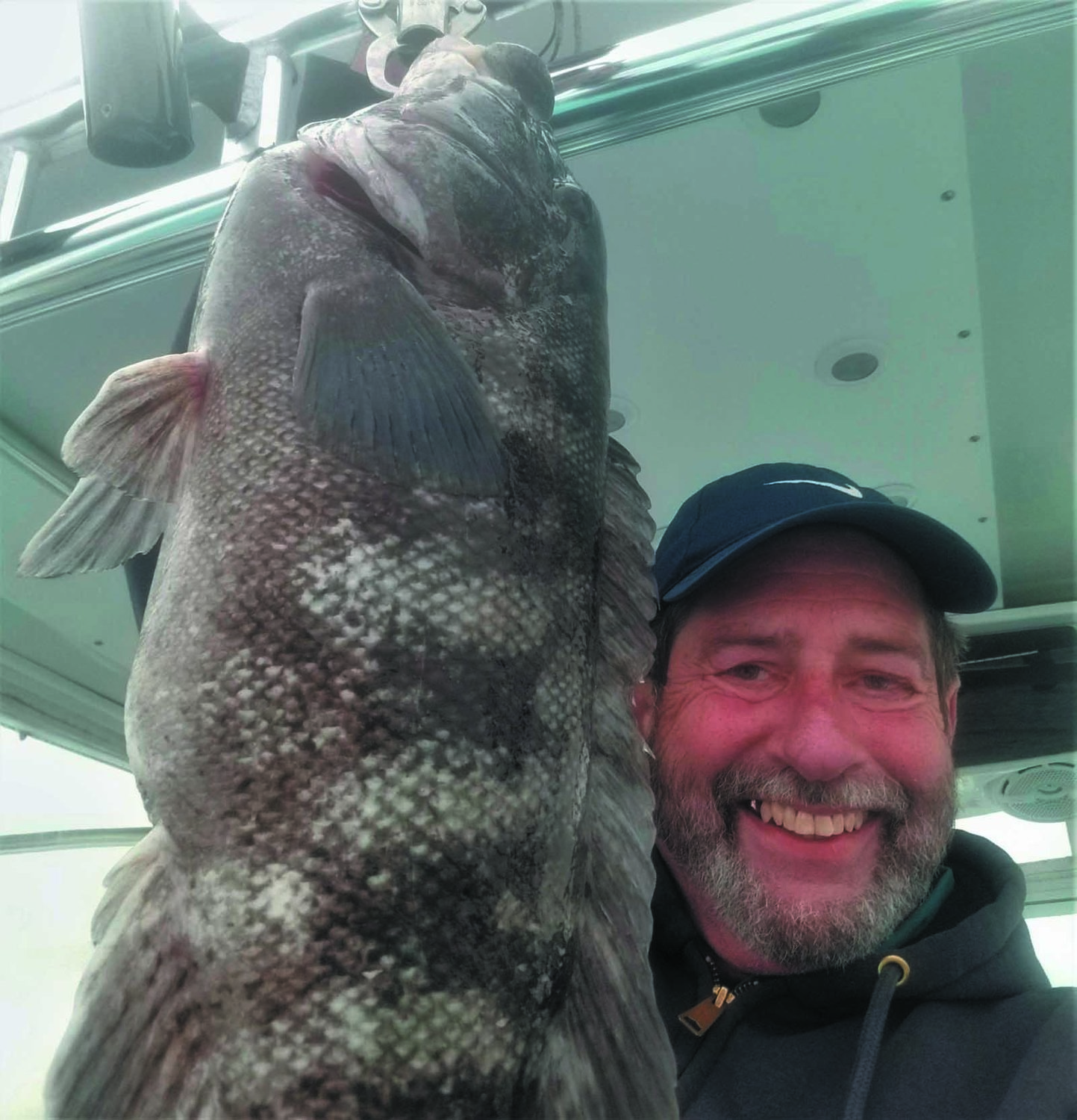
NK TAUTOG: Tautog season opened in RI and MA on April 1 with a three fish/person/day limit, 16” minimum size. Maximum of ten fish per vessel. Capt. Monti with a 2020 tautog caught with jig and green crab.

NK TAUTOG: Tautog season opened in RI and MA on April 1 with a three fish/person/day limit, 16” minimum size. Maximum of ten fish per vessel. Capt. Monti with a 2020 tautog caught with jig and green crab. (Submitted photo) Posted Wednesday, April 7, 2021 6:31 am By CAPTAIN DAVE MONTI

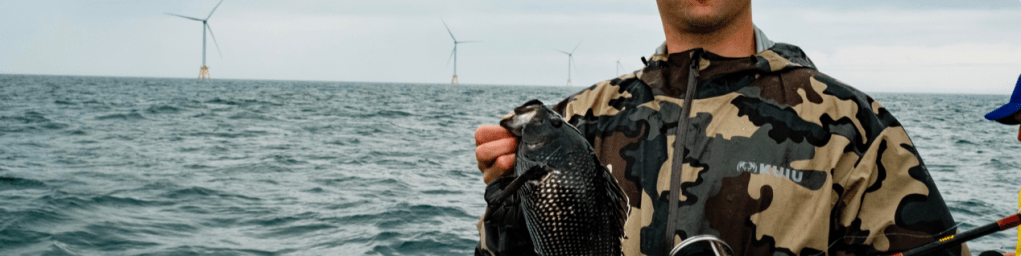
“Anglers who fish the Block Island Wind Farm (BIWF) say it has been beneficial for fishing,” said a study published in Marine Policy, an international journal of ocean affairs.

“Interview findings revealed anglers” enjoyment of the offshore wind farm as an enhanced fishing location, due to catch and non-related aspects of the experience … Respondents also value the wind farm as symbolic of progress towards green energy.” said study authors Tiffany Smythe of the United States Coast Guard Academy, David Bidwell and Grant Tyler of the University of Rhode Island.

An advanced online copy of the May, 2021 issue of Marine Policy can be found at https://www.sciencedirect.com/science/journal/0308597X.

The study titled “Optimistic with reservations: The impacts of the United States’ first offshore wind farm on the recreational fishing experience” said, “Anglers reported concerns about increased crowding around the offshore wind farm and raised concerns about potential fishing access restrictions around this and future projects.”

In public hearings surrounding northeast offshore wind farms the United States Coast Guard has repeatedly said they will not restrict fishing around or in wind farms. And, developers have said, they do not have the jurisdiction (or desire) to restrict fishing in and around their wind farms. I am not aware of any fishing restrictions that have occurred at the Block Island Wind Farm since it became operational in December, 2016 except during limited maintenance periods to ensure work crew and boater safety.

Anglers are encouraged to provide state regulators and wind farm developers in their area with negative or positive input on offshore wind developments. For a list of offshore wind farms active off Rhode Island and Massachusetts visit the Bureau of Ocean Energy Management (BOEM) website at www.boem.gov/renewable-energy/state-activities. Slow down for right whales

There is a 10-knot small vessel (less than 65’ overall) speed limit in Cape Cod Bay to protect endangered right whales from the threat of ship strikes. During the late-winter and early-spring, right whales migrate into and aggregate in Cape Cod Bay where they feed on zooplankton.

On March 21, an aerial survey of the Bay sighted 89 right whales, including 3 mother calf pairs. As we move into the spring, these whales begin to feed closer to the surface and become more susceptible to ship strikes. Ship strikes are a significant source of mortality to these endangered whales. However, the lethality of ship strikes is greatly reduced when vessels are operating at less than 10-knots speed.

For more information regarding the management of protected marine species in Massachusetts, please visit our website (www.mass.gov/marinefisheries) or call DMF at 617-626-1520. More stocked ponds in Rhode Island as trout season opens April 7

The Department of Environmental Management (DEM) announced that Rhode Island trout stocked lakes, ponds, rivers and streams opened for fishing on Wednesday, April 7. The trout season in Massachusetts has been open.

For a list of trout stocked ponds in Massachusetts visit www.mass.gov/service-details/massachusetts-trout-stocked-waters-list and in Rhode Island for a complete list of stocked waters and links to regulations and licenses visit www.dem.ri.gov/programs/fish-wildlife/freshwater-fisheries/troutwaters.php.

Late last week DEM announced that as a result of improved water level and access conditions, three additional fishing areas were stocked for the opening of trout season. They included Lake Tiogue, Coventry; Spring Grove Pond, Glocester; and Wallum Lake, Burrillville.

DEM’s Division of Fish and Wildlife is stocking over 60,000 hatchery-raised rainbow, brook, golden rainbow and brown trout in more than 100 waterways across the state. In addition, 4,000 Sebago salmon will be stocked statewide. Where’s the bite?

Freshwater trout season opened Wednesday, April 7, see above links to Rhode Island and Massachusetts stocked ponds. John Littlefield of Archie’s Bait & Tackle, Riverside, said, “When anglers are getting out (cold weather detriment for some) they are catching largemouth in the two pound range. Not a lot of large fish being taken. One customer was doing well fishing Bad Luck Pond, Rehoboth where he caught a couple of three pound fish.” Tom Giddings of the Tackle Box, Warwick, said, “Customers are doing well with pickerel and pike and Sand Pond and Little Pond in Warwick. They are taking pike on shiners and largemouth working slow moving spinners and jigs.”

Tautog fishing opened April 1 with a 16-inch minimum size in Rhode Island and Massachusetts. There is a three fish/person/day limit from April 1 to May 31. Tom Giddings of the Tackle Box said, “Customers are starting to target tautog, not a lot of anglers actually fishing but an awful lot of them are getting ready as the weather warms up.” “Not many customers are targeting tautog yet, but I expect with this warm weather this week anglers will be getting out,” said Ken Ferrara of Ray’s Bait & Tackle, Warwick.

Cod fishing. Elisa Cahill of Snug Harbor Marina said, “Customers have successfully targeting both cod and tautog south of Block Island this week.” “A few customers are catching cod off Newport, the water there seems to be the right temperature for cod.”, said Ken Ferrara of Ray’s Bait & Tackle. Party boats fishing for cod (weather permitting) include the Frances Fleet at www.francesfleet.com, the Seven B’s at http://www.sevenbs.com, and the Island Current at www.islandcurrent.com.

Dave Monti holds a captain’s master license and a charter fishing license. He is a RISAA board member, a member of the RI Party & Charter Boat Association, the American Saltwater Guides Association and the RI Marine Fisheries Council.  Forward fishing news and photos to Capt. Dave at dmontifish@verizon. net or visit www.noflukefishing.com.

Aging Energy Infrastructure

Guestwords in the East Hampton Star

By David Posnett March 17, 2021

On the South Fork of Long Island, we all know about yearly brownouts during peak demand for power in the summer. Indeed, energy demand on the South Fork is growing at almost twice the rate of the rest of Long Island.

And now we have witnessed the power outages in Texas during freezing weather. With decades of neglect of their power grids, refusal to update the necessary infrastructure, and an ill-advised policy of not building connections with out-of-state grids, many lives were lost and the economic fallout is still unknown.

Locally, two major blackouts in 1965 and 1977 paralyzed New York City and exposed the vulnerability of the power grid. The full story can be read by Googling “Gaslights to Generators,” a September 2002 article on New York City’s energy history by Meryl Feiner.

Long Island is in a precarious situation in terms of meeting growing energy demands. Historically the Island has not produced sufficient energy, and thus it imports energy from elsewhere. But with solar and now wind energy sources, this is about to change. There are plans for 4,000 megawatts from wind farms off Long Island shores and 130 megawatts from the South Fork Wind farm, the project that is furthest along.

An interesting article in Newsday by Mark Harrington, updated on Feb. 24, discusses a NYSERDA (New York State Energy Research and Development Authority) report on the required updates to the grid and the infrastructure required to manage the massive new clean energy sources being planned. Harrington quotes Tom Falcone, chief executive of the Long Island Power Authority, saying, “As you put more and more offshore wind onto the grid, think of it as water pipe. At some point you reach the limit, so in order to have more offshore wind you have to upgrade the pipe.”

If we do nothing, the report indicates, there would be a need for “curtailments,” or intentional power outages.

The total cost of the required infrastructure updates would be about $1.5 billion. The upgrades include building a 345,000-volt circuit from LIPA’s newly built Shore Road substation in Glenwood Landing to the substation in Melville, an upgrade of the South Shore transmission grid (already in process), conversion of an existing 138,000-volt transmission line in Levittown to 345,000 volts, a new interconnection line between the LIPA and Con Edison systems, solar power upgrades of various substations, and improvements that are either already part of LIPA’s capital budget or have already begun, such as upgrading transformers and switching gear and substations to higher voltages.

A full list of LIPA’s transmission system and distribution system projects was presented on Feb. 24 at the LIPA trustee meeting. The slide deck can be found at lipower.org.

I asked some experts the following question: Would these grid upgrades also be required if the source of the required extra energy were solely fossil fuel generated, and to what extent are the costs a result of converting to clean energy?

“It is clear that we need to increase the capacity and resilience of the Long Island grid, so let’s get to work on the immediate upgrades and retrofits necessary within the current infrastructure,” said Mariah Dignan of Climate Jobs NY and the Climate Jobs NY Education Fund. “But as we begin to realize the clean energy economy, we will need bulk power transmission and distribution voltage upgrades over the next decade to handle offshore wind generation, increased electrification, and a better flow of renewables from upstate to downstate and vice versa. These investments will pay off for decades to come, and labor is fighting to ensure this transformation creates good union jobs and protects Long Island ratepayers.”

Gordian Raacke, the executive director of Renewable Energy Long Island, said that if the same amount of capacity would be interconnected at the same locations, similar grid upgrades and costs would be needed for fossil fuel versus renewable energy. But it is also fair to say that fossil fuel generation could be located in other parts of the state, while offshore wind resources would have to be interconnected along the shore.

In addition, he said, there are several misunderstandings that need to be cleared up. First, the potential transmission and distribution upgrades are not associated with the South Fork Wind farm but with all of the offshore wind farms that would be connected to the Long Island grid, as well as the interconnection of distributed solar and energy storage projects. These costs would not be borne exclusively by Long Island ratepayers but shared across New York State. These are potential projects identified in studies and proposed for study. LIPA does not believe that all of these “possible transmission projects” will be built. And last, most of the transmission projects would not be needed until 2025 through 2035.

Gordian has often reminded us, from the beginning, that the energy infrastructure must be renewed or replaced regardless of wind farms. This is a really costly undertaking, and it’s terrific that PSEG is proposing to make it a state­wide charge to ratepayers.

Skybrator!

From the Guardian.

Good vibrations: bladeless turbines could bring wind power to your home

‘Skybrators’ generate clean energy without environmental impact of large windfarms, say green pioneers

The giant windfarms that line hills and coastlines are not the only way to harness the power of the wind, say green energy pioneers who plan to reinvent wind power by forgoing the need for turbine towers, blades – and even wind.

“We are not against traditional windfarms,” says David Yáñez, the inventor of Vortex Bladeless. His six-person startup, based just outside Madrid, has pioneered a turbine design that can harness energy from winds without the sweeping white blades considered synonymous with wind power.

The design recently won the approval of Norway’s state energy company, Equinor, which named Vortex on a list of the 10 most exciting startups in the energy sector. Equinor will also offer the startup development support through its tech accelerator programme.

The bladeless turbines stand at 3 metres high, a curve-topped cylinder fixed vertically with an elastic rod. To the untrained eye it appears to waggle back and forth, not unlike a car dashboard toy. In reality, it is designed to oscillate within the wind range and generate electricity from the vibration.

It has already raised eyebrows on the forum site Reddit, where the turbine was likened to a giant vibrating sex toy, or “skybrator”. The unmistakably phallic design attracted more than 94,000 ratings and 3,500 comments on the site. The top rated comment suggested a similar device might be found in your mother’s dresser drawer. It received 20,000 positive ratings from Reddit users.

“Our technology has different characteristics which can help to fill the gaps where traditional windfarms might not be appropriate,” says Yáñez.

These gaps could include urban and residential areas where the impact of a windfarm would be too great, and the space to build one would be too small. It plugs into the same trend for installing small-scale, on-site energy generation, which has helped homes and companies across the country save on their energy bills.

This could be wind power’s answer to the home solar panel, says Yáñez.

“They complement each other well, because solar panels produce electricity during the day while wind speeds tend to be higher at night,” he says. “But the main benefit of the technology is in reducing its environmental impact, its visual impact, and the cost of operating and maintaining the turbine.”

The turbine is no danger to bird migration patterns, or wildlife, particularly if used in urban settings. For the people living or working nearby, the turbine would create noise at a frequency virtually undetectable to humans.

“Today, the turbine is small and would generate small amounts of electricity. But we are looking for an industrial partner to scale up our plans to a 140 metre turbine with a power capacity of 1 megawatt,” says Yáñez.

Vortex is not the only startup hoping to reinvent wind power. Alpha 311, which began in a garden shed in Whitstable, Kent, has begun manufacturing a small vertical wind turbine that it claims can generate electricity without wind.

The 2 metre turbine, made from recycled plastic, is designed to fit on to existing streetlights and generate electricity as passing cars displace the air. Independent research commissioned by the company has found that each turbine installed along a motorway could generate as much electricity as 20 sq metres of solar panels, more than enough electricity to keep the streetlight on and help power the local energy grid, too.

A scaled down version of the turbine, standing at less than 1 metre, will be installed at the O2 Arena in London where it will help to generate clean electricity for the 9 million people who visit the entertainment venue in a usual year.

“While our turbines can be placed anywhere, the optimal location is next to a highway, where they can be fitted on to existing infrastructure. There’s no need to dig anything up, as they can attach to the lighting columns that are already there and use the existing cabling to feed directly into the grid,” says Mike Shaw, a spokesperson for the company. “The footprint is small, and motorways aren’t exactly beauty spots.”

Perhaps the most ambitious divergence from the standard wind turbine has emerged from the German startup SkySails, which hopes to use an airborne design to harness wind power directly from the sky.

SkySails makes large fully automated kites designed to fly at altitudes of 400 metres to capture the power of high-altitude winds. During its ascent the kite pulls a rope tethered to a winch and a generator on the ground. The kite generates electricity as it rises into the sky and, once completely unspooled, uses only a fraction of the electricity generated to winch back towards the ground.

Stephan Wrage, the chief executive of SkySails, says the airborne wind energy systems mean “the impact on people and the environment is minimal …The systems work very quietly, practically have no visible effect on the landscape and barely cast a shadow,” he adds.

Today, the design can generate a maximum capacity of 100 to 200 kilowatts, but a new partnership with the German energy firm RWE could increase the potential output from kilowatts to megawatts. A spokesperson for RWE said the pair are currently looking for the ideal kite-flying site in the German countryside.

Green energy can put the wind in Long Island’s sails

From the Editorial Board of NEWSDAY

Credit: Don Pollard. 

February 9, 2021 

Offshore wind is having a moment, and none too soon.

For years, it’s been clear that embracing green forms of energy like wind and solar is key to fighting climate change, which increasingly threatens our region. Now, with the auspicious alignment of recent developments, the winds of change are blowing mostly in the right direction.

Progress has been substantial, as far as it goes. There’s still lots to do. For all the plans announced by state officials, all the interest from offshore wind companies, and all the contracts signed, we still have to:

  • build the facilities to manufacture wind farm components,
  • improve port infrastructure in Brooklyn and Albany so those parts can be shipped,
  • construct the wind farms off Long Island and lay the cables to deliver the energy that will reduce our dependence on greenhouse gas-emitting fossil fuels,
  • set up training programs for workers who will maintain the farms, and
  • develop the maintenance hubs for those workers.

Delays will be inevitable. Perseverance and communication will be critical. If the permitting process can be responsibly streamlined to allow the consideration of local objections but not let them grind progress to a halt, do it. But baseless NIMBY concerns, like those raised by some Wainscott residents against the landing of an underground cable in that South Fork community, cannot be allowed to derail this fight that’s vital to the health of our region.

Gov. Andrew M. Cuomo set the stage with lofty goals: 9,000 megawatts of wind power by 2035 and a carbon-free electrical grid by 2040. With recent awards to Equinor of two more wind farms, generating 2,490 megawatts and joining three other farms already awarded, the state is nearly halfway to its target. Also announced: an agreement with Equinor to build the nation’s first manufacturing plant for offshore wind towers and transition pieces, at the Port of Albany, with finished components to be shipped down the Hudson River. Prompt completion would position New York as a manufacturing hub for the industry in the Northeast and bring hundreds of good-paying jobs and precious revenue, all of it eagerly sought by other states in the region. Stony Brook University and Farmingdale State College are developing flexible programs to train and certify offshore wind industry workers.

The Biden administration’s commitment to offshore wind and its appointment of Long Islander and former Cuomo aide Amanda Lefton to head the federal Bureau of Ocean Energy Management, the agency that oversees the development of offshore wind, are promising. BOEM under the Trump administration stymied offshore wind; now it likely will advance delayed environmental reviews and reconcile differences with New York over suitable offshore wind areas and get them leased.

There’s a lot at stake in the state’s overall green energy program, besides the juice capable of powering 6 million homes. Cuomo says it also will create more than 50,000 jobs and attract $29 billion in private investment. Good environmental policy is good economic policy, too.

Let’s keep moving forward, and keep the winds of change at our backs.

Whale Tales and Whale Facts

On Apr 5, 2023, at noon, CCE (Citizens Campaign for the Environment) put together a great webinar to address increases in whale strandings and whale deaths off the Atlantic sea shore and in particular the New York blight.

Adrienne Esposito led the discussion. She reminds us that whales are under threat from several sources, including ship strikes, fishing gear, plastic pollution, and climate change. Unfortunately, misinformation has targeted offshore wind development. Local wind projects are crucial to combat climate change, which in itself threatens whales, other marine mammals, fisheries, and our local communities.

Check out this virtual educational forum to hear from experts at the US Bureau of Ocean Energy Management (BOEM), NYS Dept. of Environmental Conservation, and Atlantic Marine Conservation Society. Learn more about the recent whale strandings and deaths, and what is being done to protect whales. Hosted by CCE, NY League of Conservation Voters, and the NY Offshore Wind Alliance.

For a complete review of the webinar, watch it on YouTube (1 hour):

https://www.youtube.com/watch?v=35bPuWhY4eMhttps://www.youtube.com/watch?v=35bPuWhY4eM

Here are some points that struck me:

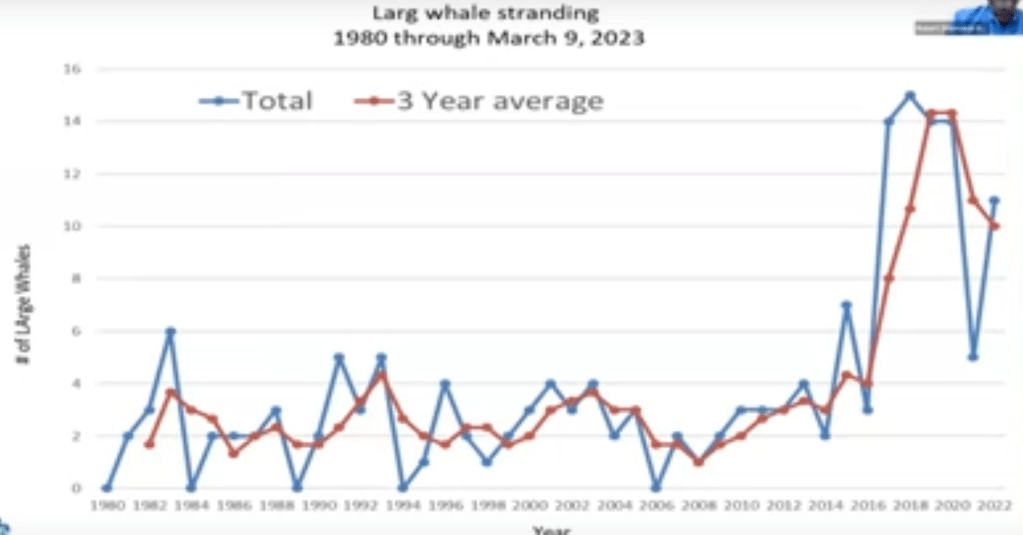
  • There is a real increase in whale deaths since 2016 (about 4-5 fold over baseline). It is over a large area of the Atlantic coastline. It involves all whale species. Leading causes are vessel strikes and entanglement in fishing gear.
  • With the return of menhaden fish schools (food for whales), whale sightings have also increased.
  • The nascent offshore wind farms have nothing to do with this real and important problem

The following are a few highlights from the webinar. Courtesy of the speakers:

Julie Tighe (New York League of Conservation voters). Meghan Rickard, NY State Dep of Environmental Conservation. Erika Staaterman, BOEM. Robert A. DiGiovanni, Atlantic Marine Conservation Society. Adrienne Esposito, Citizenscampaign

  • Large whale (with white fins) feeding on Menhaden school.
  • Increased whale strandings near NY Bight
  • Location of whale strandings
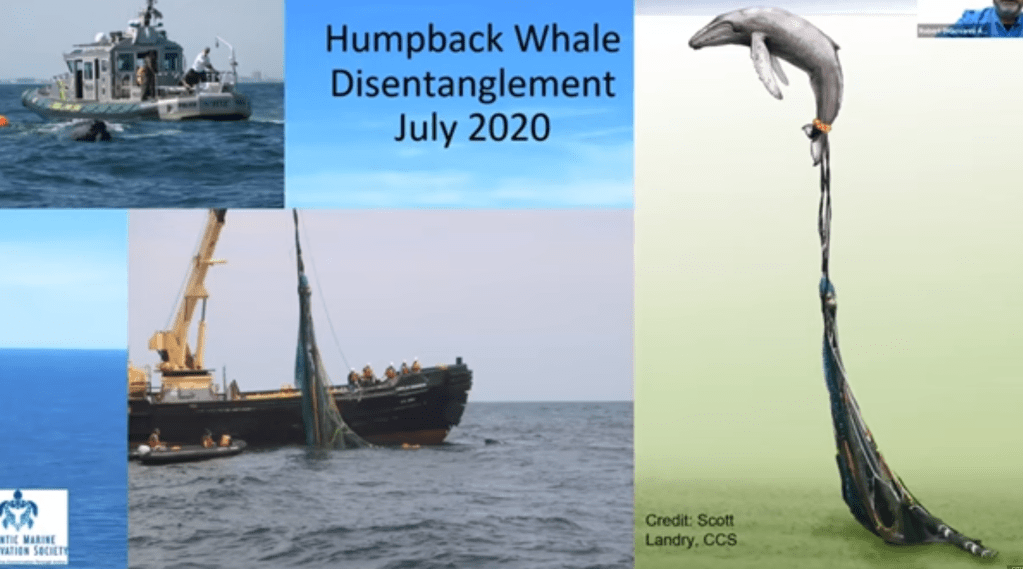
  • Entangled Humpback Whale
  • Feeding on Menhaden

A Whale of a Tale

We know that Right Whales are in danger of extinction.

  • As the ocean warms, North Atlantic Right Whales are moving north to cooler waters in unprotected zones, where they die from vessel strikes and entanglement in fishing gear and where their food sources may be scarce.
  • Fewer than 250 mature North Atlantic right whales were estimated to be alive at the end of 2018, with the total population having plummeted by 15% over the last decade.

The factors contributing to the dwindling population of Right Whales include vessel strikes, fishing gear entanglements and lack of food. Climate change is redistributing the crustaceans called copepods that Right Whales eat.

Right Whales are spending more time in Canada than they used to, which is causing serious problems for their conservation.  The deaths since 2017 are largely due to some form of human action, like boat collisions, both in United States and Canadian waters. Quite a few, though not all, of these collisions have happened in the St. Lawrence Estuary in Canada.

But the Right Whale population has also seen low reproductive rates and declining health status in recent years that can’t be explained by vessel impacts. New research points to another possible culprit: climate change.

The Gulf of Maine is warming more rapidly than nearly any other ocean ecosystem on the planet. Scientists think the reasons include changes in the path of the Gulf Stream and the way its warm waters are interacting with other currents in the North Atlantic.

“Deep waters are warming and we think that is having an impact on the life cycle, and the distribution of the critters that right whales eat,” says Pendleton. Those critters – flea-like animals known as copepods, specifically the species Calanus finmarchicus – are a critical food supply for the endangered whales. Read more about this here.

Noise pollution can mask whales’ important underwater communication calls and reduce foraging success, which affects species’ health and reproductive abilities. Ocean noise can also divert the whales from their typical migration paths into areas unsuitable for feeding or into the path of passing ships.

Thus, it is heartening that offshore wind project plans are adopting restrictions, beyond those required by law, on vessel speed and limits on loud turbine construction from pile driving and geophysical survey activities. The limitations take in to account the times when North Atlantic Right whales are unlikely to be in the area.

Given the urgency of the climate crisis, the Natural Resources Defense Council is working hard to advocate for all forms of clean renewable energy projects, including the nascent offshore wind industry.

Local NIMBY groups in East Hampton fighting offshore wind projects, such as the South Fork Wind Farm, are using the plight of Right Whales in a sinister ploy to derail these offshore wind energy projects, which would only worsen ocean warming and the lack of critical food supply for Right Whales. Yet these same groups can not even tell the difference between a Right Whale and a Humpback Whale! See their posters attached in pdf format.

The Wind Farm’s Case

Autor

  • Publication: Southampton Press
  • Published on: Nov 21, 2020
  • Columnist: Karl Grossman

It would be the biggest offshore wind farm in New York State — more than 100 wind turbines starting 30 miles east of Montauk Point. It’s being called Sunrise Wind.

A “cable bundle” containing two electric cables would be buried under the seabed and extended west from the turbines for 100 miles, making landfall in the parking lot at Smith Point County Park in Shirley, and buried underground there. The cabling would then run for 17 miles, all underground, along William Floyd Parkway and, remaining underground, along other roads, and then the Long Island Expressway, reaching the Long Island Power Authority substation just north of the LIE in Holtsville.

Sunrise Wind would generate 880 megawatts of electricity and feed into the Long Island electric grid at Holtsville. The 880-megawatts would provide for 500,000 homes, nearly half of the Long Island Power Authority’s 1.1 million customer base.

A “virtual open house” was held on the project last week. Presentations were made and questions answered by representatives of the owners of the Sunrise Wind project, Denmark-based Ørsted, the world’s largest developer of offshore wind farms, and Eversource, a product of a merger of New England utility companies that included Northeast Utilities.

Ørsted, since acquiring Deepwater Wind, owns the Block Island Wind Farm, consisting of five turbines off Block Island — the first U.S. offshore wind farm, which went operational in 2016. Ørsted and Eversource together own the proposed South Fork Wind Farm, which is to have 15 wind turbines also placed in the Atlantic east of Montauk Point.

The number of wind turbines in the Sunrise Wind project would depend on the size of the turbines used. If 8-megawatt turbines, common in new offshore wind farms, are used, the total would be 110. If the turbines would be smaller then there would be more to produce 880 megawatts of electricity. The project is “permitted for up to” 122 turbines, according to a spokesperson.

New York State last year awarded Ørsted the contract to develop Sunrise Wind after a competitive bidding process.

In the online “virtual open house,” representatives said the Sunrise Wind project would be a “catalyst” for clean energy. Here are some of the other points made by the representatives:

It would be a key to the “transition to clean energy” in New York State and the goal of Governor Andrew Cuomo and the state to have “100 percent clean energy by 2040.”

The turbines would be “barely visible” from any shore. There would be “no harmful emissions,” and Sunrise Wind would “displace 2.1 million metric tons of carbon pollution” every year.

The “cost to the average ratepayer” on Long Island would be “less than $1 per month” extra on her or his electric bill. “Construction work could begin as early as 2023” — after all necessary permits are obtained — and completed in 2024.

There’d be a “host community benefit agreement,” through which Ørsted and Eversource would provide funds. Suffolk County Community College would become the “training center in Suffolk County” for offshore wind technology. It would be the “academic arm of the initiative.”

Port Jefferson would become a “hub” for activities. Workers on the Sunrise Wind project would live in two-week shifts on a “service operational vessel.”

Ørsted “brings unparalleled expertise” to the project, with its 26 “successful offshore wind farms” and “1,500 turbines worldwide.”

Cables would be buried “the entire length of the route.” All the “construction areas” would be “fully restored.” There would be “minimal environmental impact.”

Ørsted and Eversource welcome “stakeholder suggestions.” A slogan of “we listen, we learn, we adjust” was displayed. “We are totally committed to protect the environment … and work with commercial and recreational fishing interests.”

As to why the South Fork Wind Farm and the Sunrise Wind project would have different landing points, the explanation was that the South Fork project would be sending DC electricity to Long Island, and Sunrise would be sending AC. Also, there would be a difference in the voltage sent.

Offshore wind farms are able to harvest more wind power than onshore wind projects, said the representatives. Wind isn’t blocked and turbines can be larger, it was explained.

They said Sunrise Wind would be a “game-changer,” the “first of many” similar “large-scale” U.S. offshore wind projects. Also, offshore wind is an excellent “complement” to the other major source of clean electricity — solar power.

The big ugly barge…

SOUTH FORK WIND – Field Surveys & Site Evaluation Purpose.

South Fork Wind is performing nearshore geotechnical surveys to inform the cable landing. The work will be performed by a lift boat named the Laredo Brazos – a barge that can stand out of the water for protection from wave action. The surveys will consist of three soil borings of the seafloor. The soil borings will be taken at points 780 feet, 1470 feet, and 2,160 feet from shore, directly off the Wainscott Beach.

Timeline: The vessel is anticipated to arrive on or around November 15 and activity will begin on November 16. We anticipate the work will be completed by November 25. The barge, as well as a smaller vessel named the Kristen Miller, will be visible from shore during this time. Timeline & Location

Email: info@southforkwind.com

Website: southforkwind.com

Twitter@SouthForkWind