There is already evidence of a real estate slump in the United States. A housing recession is predicted for 2020. The average price of luxury home sales is falling, as is the number of sales. Long Island specifically is suffering as sales decrease and homes lose value. This is rather astonishing given that the rest of the economy is still on steroids.
What are the reasons? The following have all been suggested.
First, baby boomers from New York are downsizing and moving to lower-tax states. Second, millennials seem to have a distaste for buying second homes and would rather rent. Third, bonuses on Wall Street fell 17 percent in 2018 compared with 2017.
Fourth, the tax changes brought on by Donald Trump: a cap of $10,000 on the amount of state and local taxes (SALT), including property taxes, that can be deducted from federal income tax. For an expensive home with property taxes of $50,000 per year, this means that $40,000 can no longer be deducted.
Fifth, as mentioned by some real estate professionals: chronic flooding, which threatens the values of houses here. According to Aidan Gardiner writing for The Real Deal, a website focusing on New York real estate news: “Chronic flooding threatens to sink the value of Hamptons homes. Hamptons homes are very likely to lose value given that they’ll face chronic flooding as climate changes and sea levels rise over the coming years, according to Bloomberg. Behind only central California, the area has the second-highest level of its property tax revenue at risk among U.S. municipalities with a high likelihood of chronic flooding in the next 12 years. Climate change is expected to bring constant floods that would tank property values, erode infrastructure, and sink tax revenue, all of which will make it harder to fund projects to battle the rising seas.”
You can check for yourself on ss2.climatecentral.org, where you can find a “risk zone map for surging seas.” See the figure appended below. You can input anything from “unchecked pollution” to “extreme carbon cuts,” depending on how you predict future policies will rein in carbon emissions.
I assumed unchecked carbon emissions along the lines of our present-day emissions, and I asked for maps of a 10-foot water level rise. The program produces maps with dark blue shaded areas that will be underwater. Here are some of the highlights for the not so distant future (2050 to 2100).
Montauk will become an island, the Napeague stretch will be underwater, and much of downtown Montauk will be too, including Route 27. Flooding of Route 27 across Napeague will start with just a three-foot rise in sea water levels, shutting down access to Montauk.
Homes all around Accabonac Harbor will be flooded. Gerard Drive and Louse Point will be submerged. Maidstone Park, Sammy’s Beach, and Cedar Point will be gone. Barcelona Point and the Sag Harbor Golf Course will become an island.
Beach homes in Amagansett, homes along Two Mile Hollow Beach, homes around Hook Pond, Georgica Pond, and Wainscott Pond will all be underwater. Indeed, a few homes on Beach Lane in Wainscott will be submerged. That is where the cable from the South Fork Wind Farm is proposed to come ashore and where some of its opponents own property.
Much of Sag Harbor Village will be underwater, and North Haven will be a real island.
Up and down Long Island, the homes close to the South Shore will be underwater, and Fire Island will no longer exist.
The North Shore, too, will be flooded, and Greenport will be on an island.
Kennedy International Airport will be underwater.
It is not just someone else’s problem. Loss of value of high-end homes means loss of significant local business and loss of jobs, and it spills over, resulting in loss of the value of your own property regardless of whether it is in particular danger of flooding.
Showtime’s “The Affair” recently wrapped up its final season, and part of it was set in mid-21st-century Montauk, with warming temperatures and rising seas. The show forecasts what life will look like in 34 short years, including mass transit that routinely short-circuits because of flooding, coastal communities plunged into near-total darkness, and shoreline towns without basic municipal services.
We had better support clean energy (including offshore wind) and work to decrease our carbon footprint. It is urgent.
David Posnett is a member of the Steering Committee of Win With Wind.
OpinionLetters, By Newsday Readers December 16, 2019 10:02 AM
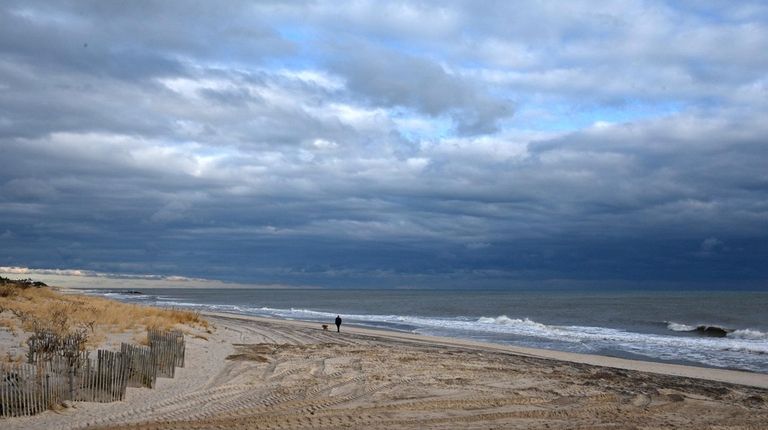
Richard DeRose of Wainscott walks his dog at the town beach on Beach Lane in Wainscott, likely site of a cable landing for the South Fork Wind Farm. Dec. 5 Credit: Newsday/Mark Harrington
Thanks for your Dec. 9 news story on the South Fork offshore wind project [“Negotiations over cable”] about talks regarding the landing site of an electrical cable. As a former commissioner of the state Department of Environmental Conservation, I’m no stranger to local opposition to projects like this. But the opposition by Citizens for the Preservation of Wainscott to the cable landing is “not in my backyard” on steroids. I encourage this small group of owners of second homes to reconsider.
The cable landing in Wainscott is preferred because it is the least environmentally disruptive and would affect the fewest people for the shortest period. Unfortunately, despite the need to rapidly move away from fossil fuels, the citizens group is taking an irrational “anyplace but here” attitude. The temporary inconvenience from burying the cable would be minimal, and would occur in the offseason, when most owners of second homes are not around.
Connecting this offshore energy to the Long Island grid is now being reviewed by several state agencies. I believe this time-tested process, along with decisions by local officials, will produce a project that is good for the South Fork, Long Island and the state. I urge citizens of Wainscott to support it. After all, coastal property owners have the most to lose if New York does not lead the way in combating climate change.
Joe Martens, East Hampton
Editor’s note: The writer is director of the New York Offshore Wind Alliance, a coalition of organizations supporting wind power.
Australian firefighters battle the Gospers Mountain Fire on Dec. 21. (Dan Himbrechts/AAP Images/AP)
By Sarah Kaplan Jan. 1, 2020 at 3:45 p.m. EST. The Washington Post: Science
At the start of the previous decade, Kallan Benson was 5 years old, her favorite story was “The Secret Garden,” and Earth was in the midst of its warmest year on record. Benson had heard about climate change (her mother is an environmental scientist), but she didn’t know world leaders had just signed an agreement calling it “one of the greatest challenges of our time.” She cared about Earth, but she trusted adults to protect it.
She doesn’t feel that way anymore.
By the final year of the decade, the planet had surpassed its 2010 temperature record five times. Hurricanes devastated New Jersey and Puerto Rico, and floods damaged the Midwest and Bangladesh. Southern Africa was gripped by a deadly drought. Australia and the Amazon are ablaze. Global emissions are expected to hit an all-time high this year, and humanity is on track to cross the threshold for tolerable warming within a generation.AD
The 2010s were a “decade of disappointment,” said Benson, now 15 and a national coordinator for the youth climate organization Fridays for Future. If the world is to stave off further disasters, the next decade must be one of unprecedented climate action, she said.
“This decade that we’re going into now will be the most important of our lives,” Benson said. “We’re kind of running out of options. And we’re running out of time.”
Students gather at John Marshall Park, blocks from the U.S. Capitol, to protest climate change on Sept. 20. (Astrid Riecken for The Washington Post)
Ten years ago, the United Nations released its first “emissions gap” report detailing the disparity between commitments made by nations to reduce greenhouse gases and what is needed to meet global temperature targets. It estimated that countries should be curbing emissions about 3 percent per year.
But that hasn’t happened, said Surabi Menon, vice president for global intelligence at the ClimateWorks Foundation and a steering committee member for the U.N.’s emissions gap reports.AD
“We’ve left ourselves with a very narrow window to take the kind of action that needs to be taken,” she said.
The 2015 Paris climate accord — the first-ever global agreement to limit warming to “well below 2 degrees Celsius” — was important, Menon said. But the promises made at that meeting fell short. According to the latest emissions gap report, temperatures can be expected to rise 3.2 degrees Celsius above preindustrial levels by the end of the century, unless the world’s top emitters increase their Paris commitments.
Right now, most aren’t on track to meet even their most modest targets. The world is already about 1 degree Celsius warmer than it was before humans started burning fossil fuels. Global annual emissions have increased 4 percent since the Paris agreement was signed. And the average concentration of carbon dioxide in the atmosphere — a number that ultimately determines our fate, in the words of Phil DeCola, who chairs the science team for a World Meteorological Organization greenhouse gas initiative — is the highest in human history.
Meanwhile, improved scientific models found that even 2 degrees of warming — once thought to be a reasonable target — could be practically intolerable in parts of the world. To get on track to achieve a less disastrous 1.5-degree temperature rise, a landmark U.N. report found that nations must nearly halve emissions by 2030.
Youths pull out an ox stuck in muddy waters in the drying Mabwematema dam in Zimbabwe on Dec. 25. (Zinyange Auntony/AFP/Getty Images)
The United Nations’ 1.5-degree analysis provoked widespread alarm after it was published in 2018. Politicians referred to the report at rallies; teenagers quoted it during school walkouts.AD
“If we don’t do something by then,” 14-year-old climate activist Alexandria Villaseñor said in February, referring to 2030, “it will be the end of my world.”
But climate scientists caution against treating 2030 as a deadline and 1.5 degrees as a threshold for extinction.
“Climate change is not a cliff. It’s not a pass-fail course,” Georgia Tech researcher Kim Cobb said. “If we meet the 1.5 target, there may still be tons of ugly surprises. And if we don’t meet it, it’s not that everybody’s going to die.”
According to Cobb, the report is better understood as a road map for navigating the perilous path to sustainability.
“Our decisions over the next 10 years will affect the magnitude of climate change for centuries to come,” she said. “I don’t think it can get more sobering than that.”
A man walks among debris at the Mudd neighborhood, devastated after Hurricane Dorian hit the Abaco Islands in Marsh Harbour, Bahamas, on Sept. 6. (Marco Bello/Reuters)
The first and most important step will be reducing fossil fuel consumption, experts say. According to the latest emissions gap analysis, the past 10 years of inaction have more than doubled the rate at which emissions must fall; to meet the 1.5-degree goal, emissions must be cut by 7.6 percent each year.AD
Such action would require “unprecedented” transformation of society the report acknowledged.
But many of the solutions needed — both economic and technological — already exist. The report called on the global community to replace coal power with renewable energy, decarbonize transportation and manufacturing, and help developing nations build green infrastructure to meet their growing power needs.
Ending subsidies for fossil fuels could reduce global emissions 10 percent by 2030, the U.N. has found. And eliminating “short-lived” greenhouse gases — including methane, black carbon and fluorinated gases, which linger in the atmosphere less than carbon dioxide but trap more heat — over the next 20 years could help Earth avoid between 0.3 and 0.8 degrees of warming by 2050, research suggests.
Menon draws hope from progress that has been made on the ground in the past decade, even as global leaders fell short. Global renewable energy capacity has quadrupled since 2010, largely because of improved technology and falling costs, she noted. People increasingly see climate change as a threat; a Washington Post poll this year found that 76 percent of American adults view the issue as a “major problem” or a “crisis.” This year’s global climate strikes, led by teenagers such as Benson and Swedish activist Greta Thunberg, were among the largest environmental protests in history.
“We know what we have to do,” Menon said. “And we know there are pathways, there are policies, and there are people willing to do it.”
A reforestation assistant measures a newly planted tree in a field damaged during illegal gold mining in Madre de Dios, Peru, on March 29. (Rodrigo Abd/AP)
The rate at which greenhouse gases are removed from the atmosphere must also increase, said Tufts University climate scientist William Moomaw, a contributor to the United Nations’ Intergovernmental Panel on Climate Change. Natural systems currently absorb more than half the carbon people produce, and a 2018 study found that conservation, restoration and improved land management practices could reduce the United States’ net emissions by as much as 21 percent. But cutting down forests, dredging wetlands and polluting the coasts reduce that capacity.AD
“If we don’t actually reverse the rise of carbon dioxide, so that we are lowering the concentrations in the atmosphere, it’s just going to go on getting worse and worse,” Moomaw said.
In the bleak report released this August, the United Nations forecast the consequences of inaction on land. Warming beyond 1.5 degrees will lead to high risk of drought, wildfires, destructive hurricanes and outbreaks of agricultural pests, scientists said. Increased atmospheric carbon dioxide levels could lower the nutritional quality of crops and raise grain prices. Millions will be at risk of losing their homes, livelihoods and lives to natural disasters, and countries will be destabilized by mass migrations.
Many parts of the world are already experiencing this extreme change; a Washington Post analysis this year found roughly 10 percent of the globe has surpassed 2 degrees of warming since the preindustrial era.AD
“The stakes are high. The climate impacts are severe. And people almost everywhere in the world are experiencing that and waking up,” Menon said. “That gives me hope.”
It’s when she considers the political decisions needed to fight warming that she feels pessimistic.
At the recent COP 25 climate talks in Madrid, the world’s leading emitters, including the United States and China, failed to increase their commitments to cut emissions. Officials deferred until next year the task of establishing a global carbon trading system.
“It felt like betrayal,” said Benson, the 15-year-old activist, who lives in Annapolis. “But for me, it means that I have to keep doing what I’m doing. Keep soldiering on.”
On a chilly Friday in December, shivering through her weekly climate strike at the Capitol, the teenager tried to imagine what the next 10 years might look like. But the normal life milestones — dates and dances, college, a job — were hard to picture. Until the global climate outlook changes, Benson can’t envision doing anything but activism.AD
It all depends on what happens to the planet. And that depends on what people decide to do.
Finally, Benson sighed. “I really can’t predict the future,” she said. “There’s so many ways this decade could go.”
Correction: An initial version of this article misstated Phil DeCola’s title. He is science team chair for the Integrated Global Greenhouse Gas Information System, an initiative of the World Meteorological Organization’s Global Atmosphere Watch program.
Initially, Citizens for the Preservation of Wainscott claimed that it supported the South Fork Wind Farm but did not want the cable buried under Beach Lane. Interesting, Wainscott made no objection earlier in the year to East Hampton Town and Suffolk County burying nine miles of water pipe in Wainscott roadways (including Beach Lane) when the water quality of Wainscott’s aquifer was called into question.
Next, C.P.W. argued that the cable should come ashore at Hither Hills. The plan was to bury it under Montauk Highway from Hither Hills through Amagansett and East Hampton Village and then up Route 114 to the Cove Hollow Road substation. This would be very disruptive to homes, businesses, and traffic along this 11-mile route. This would take two off-seasons to complete. When asked why this was preferable, Citizens for the Preservation of Wainscott had no answer. F.Y.I., Beach Lane has six year-round residences.
Now, C.P.W. is opposed to the wind farm because the price negotiated with LIPA is too high. The agreement between Deepwater/Orsted and LIPA (which was approved by the New York State Public Service Commission) was the result of a public bid, which Deepwater/Orsted won because it provided electricity at the lowest cost. Now, four-plus years later, new wind farm bids are coming in even lower. Such prices will benefit South Fork residents since PSEG prices are based on a mix of all the prices it pays for the electricity it delivers. Lower prices for power from the newer wind farms will lower PSEG costs, and thus bills to consumers will go down.
Recently, C.P.W. claimed, without any supporting details, that within five years there would be more efficient and affordable ways to solve the power needs on the East End. Ninety-nine percent of scientists agree climate change is a current crisis. We need immediate action to address South Fork power needs, air pollution, health risks, sea level rise, as well as the existential crisis of climate change.
Finally, C.P.W. complains that Orsted is breaking its promise to explore the Hither Hills route in the Public Service Commission settlement negotiations, which are ongoing. Significant time was spent on the Hither Hills route during those negotiations, and on Jan. 8, at the request of C.P.W., an additional settlement negotiation will be held to allow C.P.W. to present its alternative route.
Orsted has gone out of its way to cooperate with C.P.W. The only deception has been on the part of C.P.W., which has little credibility. Clearly, C.P.W. is just a small, moneyed Nimby group who wants electricity for Wainscott without any involvement or inconvenience on their part.
It’s time for C.P.W. to get with the program and support the wind farm, which will provide electricity to 70,000 South Fork homes, including the 700 or so in Wainscott.
Corn crops affected by Texas drought, 2013 | Smith Collection/Gado/Getty Images
Letter to the Editor in the East Hampton Star East Hampton December 2, 2019
Dear David,
At check-out in Brent’s Store in Amagansett, a wizened fisherman blamed state regulators for the fact that the tags he’s allocated now allow him to catch barely enough fish for his own family table. And as a New York Times headline announced, “The Scallops Are All Dead.”
While we look for local influences, we ignore at our peril the fact that it is a global problem.
This week, to pick one from a thousand stories, The Washington Post profiled Tombwa, Angola, where in the 1990s there were 20 fish factories processing tons of fish coming from the sea. Now there is one factory left. The fish species recently thriving there have collapsed in the overheated water. Trawlers ranging from distant ports are gobbling up what remains.
Ten years ago Bill McKibben wrote, “Climate Change is about whether you eat or don’t eat.” Deniers called it alarmism.
This year, as temperatures in Bordeaux reached 106 degrees, the vineyards were parched and wine production was down 13 percent. Corn production suffered the same fate.
In the American Midwest unprecedented rain bombs flooded the fields and destroyed billions of dollars’ worth of crops. Last year (or was it the year before?) multi-year drought destroyed countless acres of nut orchards that had been prosperous for generations in California. A recent Intergovernmental Panel on Climate report predicts a 2 to 6 percent decline in worldwide crop yields per decade going forward, at the same time as population swells.
Sidewalk experts, including the entire Republican Party, still scoff at the science. “These scientists can’t make up their minds. One day it’s drought, the next day it’s flood! Which is it, they don’t know what they’re talking about. They can’t predict the weather next week, and they claim to predict it 20 years from now. Gimme a break!”
More people now understand that we should have listened to James Hansen when he was informing the American Congress 30 years ago about climate disruption. Imagine how far we could have come in 30 years toward slowing the onset. Still we dither instead of taking personal responsibility for the problem.
Drive down any street lined with parked cars and note that most of them are SUVs. Their growth in popularity has canceled out the benefits we might have gained in the incipient move to electric vehicles. We burn as much gas now as we did before electrification because mammoth SUVs use more gas than the smaller cars we used to drive, not to mention the sky parade of private jets roaring in and out of our airport. So much for self-regulation in the face of global catastrophe.
Demagogues and religious zealots around the world can turn men without hope into terrorists. This is just the beginning. The World Bank projects 143 million climate-displaced migrants by 2050, and stresses that this is a lower bound estimate, with the numbers certain to go much higher, perhaps sooner, assuredly later.
As we approach the 2020 elections, no matter how you have voted in the past, if you care about fish, or food in general for the children you love, remember that we have two parties in this country with radically different attitudes about climate change. Forget about the personal foibles of candidates that the media love to dwell on.
Remember that one party makes its living serving the interests of the fossil fuel industry. The other party is finally listening to scientists and young people who will inherit this planet, and committing to meaningful action. Climate change is no longer about 2100, Bangladesh, or polar bears. It has come to this: not just in the long run, but for millions alive today in America, including the fisherman at Brent’s, nothing else matters.
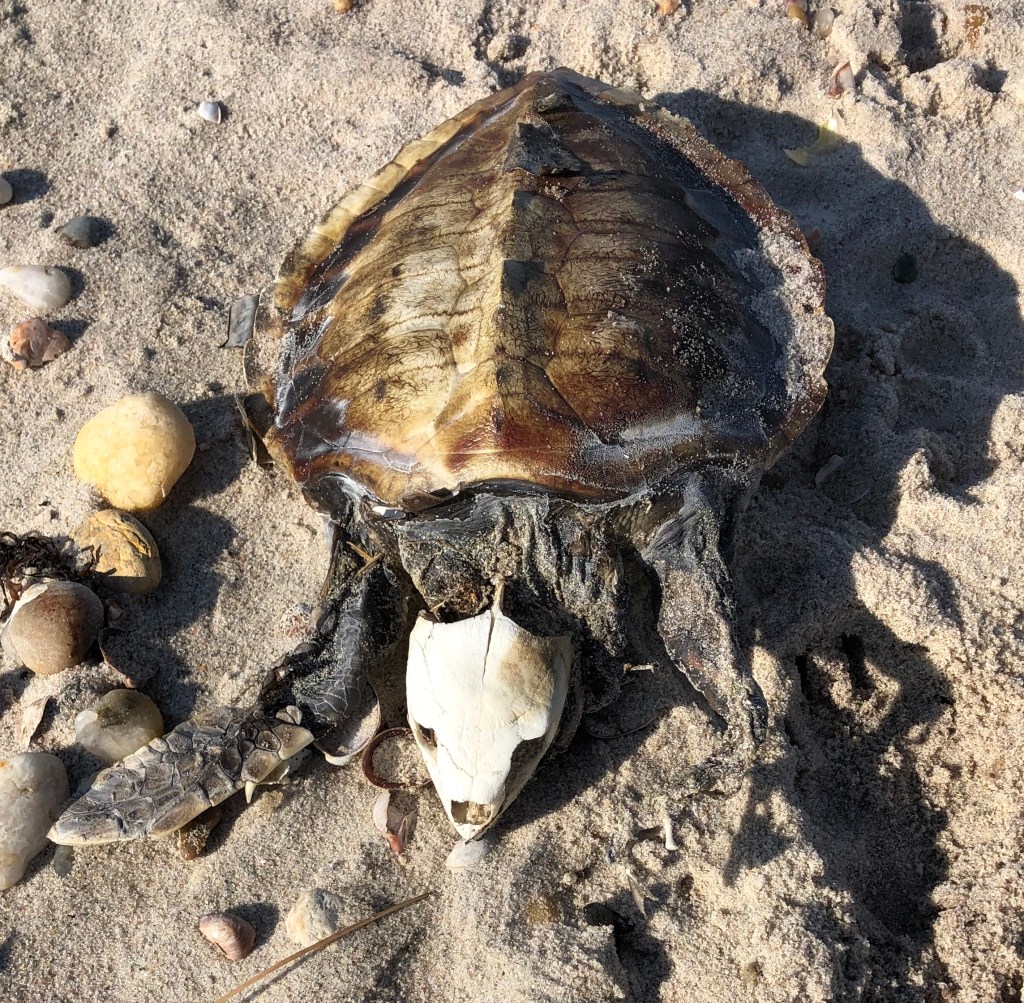
On my daily beach walk I came across this dead animal (about 1 week ago, on the Lion Head beach close to the entrance to Hog Creek, in Springs, East Hampton):
Based on the pictures I took, it’s now been identified as Kemp’s Ridley Turtle. This is a critically endangered species. In fact it is the most endangered sea turtle species!
Obviously we would all like to know why this rare animal showed up on our beach, and what might have caused its death.
Adult turtles which reach sexual maturity at the age of 7-15 years, measure about 27″ in length. This specimen measured about approx. 15″ and was therefore a juvenile.
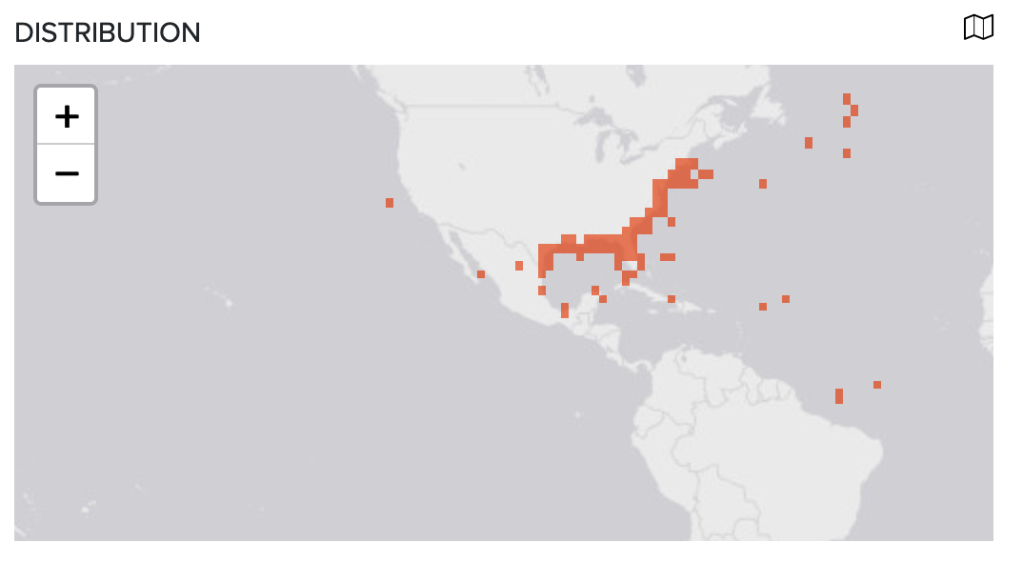
Kemp’s Ridley can be found along the Atlantic coast as far north as New Jersey. Mature adults migrate back to their nesting beach in Mexico every year: female Kemp’s Ridley turtles come together all at once in what is known as an arribada, which means “arrival” in Spanish. Nearly 95 percent of Kemp’s Ridley nesting worldwide occurs in Tamaulipas, Mexico. Nesting is usually between May and July, and females will lay up to three clutches of 100 eggs that must incubate for 50-60 days.
Hatchlings spend up to 10 years in the open ocean as juveniles. Kemp’s Ridley turtles occupy “neritic” zones, which contain muddy or sandy bottoms where their preferred prey is plentiful. Even in the ocean, the Kemp’s Ridley turtles rarely swim in waters deeper than about 160 feet.
Kemp’s Ridley turtles face many threats to their survival including incidental capture in fishing gear, or bycatch, egg collection by predators and climate change.
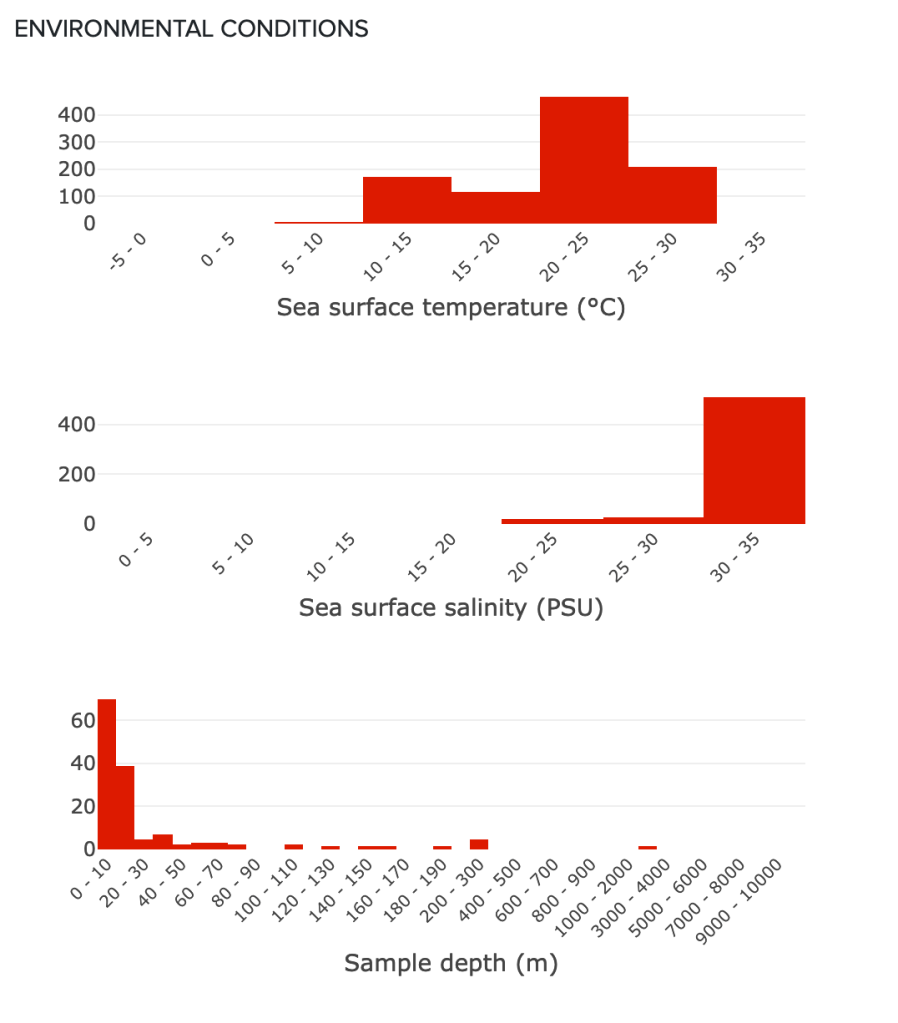
What was the cause of death for our turtle? Kemp’s Ridley turtles do not tolerate cold water below 8 degrees Celsius. East Hampton waters are currently about 10 degrees Celsius. So it seems that the turtle was too far north for its comfort zone. Note that it’s left front flipper seems to be missing or seriously mangled. This suggests that the turtle may have been injured, perhaps by fishing trawlers. Incidental take by shrimp trawlers in the gulf of Mexico is a recognized hazard for this species.
Finally, there is the possibility that ocean acidification from climate change has altered the food chain for this species as noted by OCEANA. Kemp’s Ridley turtle feeds on mollusks, crustaceans, jellyfish, fish, algae, seaweed, and sea urchins. But juveniles (such as our specimen) feed on crabs[13] and on bay scallops.
It’s interesting that bay scallops in the Peconic bay have recently suffered a die-off discussed elsewhere on this blog and possibly related to ocean acidification.
Bottom line: you don’t have to look far to witness a species in trouble!
Interesting website where you can find data on any species: f.ex. Kemp’s Ridley turtle
I note that this species likes waters with high salinity (over 30 PSU), see above. The following map shows that our waters around Long Island have much lower average salinity (less than 25 PSU). Thus both the low temperature and the low salinity represent a hostile environment for Kemp’s Ridley Turtles.
WWW is a friend of fish and all the creatures living in our oceans!
Even as the oceans are acidifying and
warming at alarming rates, and species are migrating northwards, the opposition
to off-shore wind energy suggests wind farms will bring harm to fish, or to
whales, etc. Healthy oceans spell abundant fish and are good for the
fishing industry and some fishermen recognize this.
In our opening statement regarding the
South Fork Wind Farm, pinned to the top of this blog it states:
WILL THIS HURT OUR FISHERMEN?
After listening to commercial fishermen, Bureau of Ocean Energy Management made
sure that wind turbines and cable will avoid Cox’s Ledge, a valuable commercial
fishing area. In fact, existing wind turbines off Block Island attract marine
life to them, imitating an artificial reef.
For years, researchers have warned that the increasing acidity of the oceans is likely to create a whole host of problems for the marine environment. Check it out: the evidence is already here.
One of the biggest problems is that zooplankton is shifting poleward as a result of warming ocean temperatures. The findings, published in the journal Nature, show the widespread impact climate change is having on marine ecosystems. Scientists have warned that while some species will be able to follow their food source to new waters, many others will not. Even at 1 degree [Celsius] of warming, species have to adapt because their food source has disappeared. As an example, read about the migration of stingrays that have wiped out oyster beds in the Chesapeake Bay and have moved to the Peconic Bay this year!
Here is something fun you can do. Go to https://poshtide.threadless.com/collections. Pick your favorite fish (or shell fish) design and order a holiday gift: tee shirt, slippers, back pack, pillow, beach towel, zip pouch, or even a shower curtain! If you are on Instagram check out @staceyposnett an incredibly gifted artist and designer and a big environmentalist. You can also order custom items which include the Win With Wind logo.
Publication: The Southampton Press
By Michael Wright
Nov 5, 2019 10:25 AM
Nov 5, 2019 4:59 PM
Dead Bay Scallop
A massive and mysterious die-off of bay scallops over the
past summer wiped out as much of 95 percent of the valuable and iconic
shellfish in parts of the Peconic Bay system, raising concerns about the
effect that climate change may have on the future of the East End’s
most famous natural resource.
The scale of the losses, the
scientists who have documented the destruction said, is so great in some
areas as to be reminiscent of the devastation wreaked by some of the
infamous “brown tide” algae blooms of the late 1980s and early 1990s,
which decimated the wild stock and all but ended a centuries-old
commercial fishing industry that relied solely on harvests from the East
End’s bays.
The cause of this year’s devastation is not
immediately clear, but scientists say that the arch-enemy of bay
scallops — algae blooms like brown tide and the more recent “rust tide” —
do not appear to be at fault, and other likely culprits also do not
seem to be to blame.
What’s left to blame, according to one of
researchers who has tracked the die-off, is a confluence of
environmental conditions and the stresses of the scallops’ own
biological cycles that may have killed the shellfish, even as they sowed
the seeds of next year’s stock.
There is some good news amid
the devastation, primarily because half the reason that the scale of the
die-off is remarkable is that there were so many live scallops to start
with — and they appear to have spawned before they died, leaving huge
numbers of their offspring in their place.
Population Takes A Nose Dive Surveys conducted by Cornell Cooperative Extension biologists last spring had revealed that the annual “set” of young-of-the-year scallops was enormous and on track to support a commercial take rivaling or surpassing those of the robust hauls of the last two years.
But when the scientists donned wetsuits and returned to their underwater survey areas throughout the Peconics early last month, they found the ghostly signs of an epic massacre: thousands of scallops sitting where they died, their shells gaping open.
“We call them ‘cluckers,’” Dr. Stephen Tettelbach, who leads the surveying for Cornell, said of the dead scallops, whose twin shells have remained attached and sitting on the bay floor. “Based on the cluckers, it looks like the mortality happened a while ago — a few months, probably. The pattern was the same everywhere we went — there were no freshly dead adult scallops. They had no tissue left in them. So whatever happened to them happened a while ago.”
A longtime marine biology professor for Long Island University at Southampton College and C.W. Post College, Dr. Tettelbach has been conducting bi-annual surveys of scallop populations since LIU and Cornell began an effort to restore the scallop stocks depleted by the brown tides that beset the bays between 1986 and 1995. Through the Cornell hatchery in Southold, the initiative released more than 10 million seedling-sized scallops into the bay over the last two decades in the hope of restoring the spawning foundation for the species.
Looking For Answers Since discovering this year’s die-off, Dr. Tettelbach and other scientists have been exploring what could have caused the mortality.
The destruction of harmful algae blooms was quickly ruled out, because there were none in the Peconics this year — the second straight year that the destructive successor to the brown tides, a red algae bloom that scientists have dubbed “rust tide,” has been absent from local bays, after a 15-year run of increasingly dense blooms.
Dr. Tettelbach himself had pinned a large die-off of scallops in the same area in 2012 on the dense blooms of rust tide that killed what had looked to be a robust stock just weeks before the harvest began.
The second thought about this year’s event — a disease of some sort — also is being seen as unlikely, because the die-off does not appear to have extended to juvenile scallops, which the survey divers saw alive and in great abundance.
And the vast extent of the mortality could not be chalked up to the usual cast of submarine characters that prey on scallops like crabs, whelks and some fish species.
But there was a wild card this year in the form of an invasion of a certain species of shellfish-eating stingrays that have wiped out oyster beds in the Chesapeake Bay.
Thousands of cownose rays, a brown-winged creature that feeds primarily on shellfish, swarmed into East End waters in July and August, roaming the bay bottoms in schools of dozens or hundreds.
Dr. Tettelbach said there were accounts of the rays being seen in Hallock Bay, in Orient, but he has not yet confirmed that they made their way deep into the Peconics. He said the rays could explain the disappearances in some of the areas where large number of scallops had been seen in the spring, and now there are no signs of them at all.
But the species would not be easy to blame for the full extent of scallop losses this summer, since there were so many intact shells left behind as a sign that the scallops simply died where they sat. The shells of scallops set upon by the rays would be crushed, he said.
A Matter Of Climate? Eliminating those considerations turned the former professor’s critical thinking to other environmental factors, and the warm temperatures of the summer.
Data from water monitoring stations at the western end of the Peconics revealed that water temperatures hovered around 84 degrees for several weeks this summer — an unusually long stretch of exceptionally high temperatures, and near what is understood to be the lethal limit for scallops.
In a typical parallel, levels of dissolved oxygen in the water were also very low — near zero at times — which typically will result in the death of any marine species.
But those conditions have occurred before at various times of past summers, and broad die-offs of scallops were not seen.
Dr. Tettelbach said his hypothesis is that the high water temperatures and low dissolved oxygen levels had set in early enough this year as to coincide with the weeks of early- to mid-summer when scallops are going through their first spawning cycle — some will spawn again in the fall — which can weaken them and make them more sensitive to environmental conditions.
“What I’m thinking is that the stress from spawning combined with environmental stressors may have been the cause,” he said, noting that if his hypothesis is correct, it would exacerbate concerns about a trend of warming waters. “We’ve had water temperatures in the Peconics over 80 degrees the last five years. Years ago, we never saw that.”
Impacting Local Economy Word of the scientific findings was not news to area baymen, some of whom routinely do their own pre-season surveying to keep tabs on their economic prospects for the fall.
Many didn’t even set out in their boats in search of scallops on Monday, the first day of the season in New York State waters.
“I went clamming today,” Edward Warner, a bayman from Hampton Bays, who is also a Southampton Town Trustee, said on Monday. “The only other time I can remember not going scalloping on the first day was, maybe, 1986, the first year we had the brown tide.”
Among those who did go, many found little return for their efforts.
“I had 14,” said Stuart Heath, a bayman from Montauk who scoured traditional scallop grounds in Shelter Island Sound. “I went all around North Haven, from Margarita guy’s house … to Sag Harbor, around the moorings, Barcelona, all around Northwest. Terrible. We’ve had a terrible year already — now this.”
Wainscott bayman Greg Verity said he ran his small boat across to the North Fork and found enough scallops to fill several bushel baskets, but he was still well short of the 10 bushels that a bayman is allowed to harvest each day.
East Hampton’s baymen said there’s only a faint glimmer of hope, when East Hampton waters open next week, that there may be some scallops lurking in areas that haven’t been prospected.
The Cornell scientists conduct their surveys in the string of bays connected to Great Peconic Bay, from Flanders Bay in the west to Orient Harbor in the east. They do not survey any of the waters off East Hampton — where scalloping is not allowed until this coming Sunday.
Pre-season scouting has not given East Hampton’s baymen much cause for hope, either.
Mr. Heath and Mr. Verity said they’d heard talk of scallops in Three Mile Harbor, where the town releases thousands of hatchery-raised baby scallops each year. But that supply is often depleted quite quickly, especially when the harvest in other areas is poor.
On Monday evening, Mr. Verity and Sara Miranda were counting themselves as lucky while they shucked their way through the briny pile of scallops on a steel table set up in a trailer next to Mr. Verity’s cottage in Wainscott.
“I’ll sell ’em to whoever wants ’em,” he said, as he flicked the glistening white morsels of meat into a pile.
The scene was not being replicated in many of the seafood shops around the region.
“So far, we’ve got nothing, not even one bushel,” said Danny Coronesi at Cor-J Seafood in Hampton Bays, one of the areas largest buyers.
“I’ve been here a long time. We’ve never had this. Even on bad years, opening day some guys would come in with them.” He added, “We had thought this was going to be a great year.”
Comment from Win With Wind: Scientists quoted think global warming is causing this die-off. Are scallops the canary in the coal mine for the marine environment and when will all local fishermen understand that global warming will destroy their industry, not offshore wind?
Kinsella’s
price calculation of 24.6 cents/kWh is hilarious! He can’t be serious about
just adding the two numbers.
To
calculate the combined per kWh cost of the 130 MW project one has to calculate
the weighted cost of each component:
Output from the first 90 MW at an agreed starting price of
16 c/kWh with another 40 MW at 8.6c/kWh results in a price of:
(90 MW x
$0.16 + 40 MW x $0.086)/(90 MW + 40 MW) = $0.137231 or about 13.7 cents per
kWh in the first year.
Simple
arithmetic. And LIPA’s Levelized Cost of Energy (LCOE) calculation over 20
years on page 3 of their fact sheet confirms the combined price in the footnote
as 14.1 cents/kWh:











 WIN WITH WIND